MTT Survival Guide: The Right Way to Defend Against Turn Probes
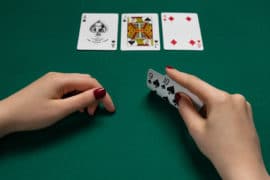
Well, you checked back the flop like an intelligent, disciplined, strong poker player. But now they’re reaching for chips…
They’re probing the turn!!!
“Fml. Turn probes. WHY.”
Get a hold of yourself.
In today’s article, you’ll learn how to defend against turn probes in tournaments like an absolute champion.
Here we go.
Don’t Flop the Flop
To get flop play right, you need sound preflop fundamentals. To get turn play right, you need both. Ensuring you play the flop well protects you from getting wrecked on the turn when facing your opponent’s probe.
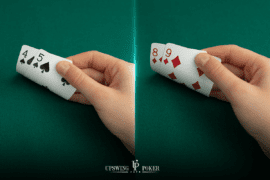
Let’s say you’re playing 50bb effective stacks and you open J5s from the Button. The Big Blind defends and checks to you on 6s 6h 5d.
You want to protect your pair of 5s and get some value from their A-highs and straight draws, so you go ahead and deploy a small 30% pot bet, and they fold.
No harm. No foul. WP.
Well, actually, it’s not all well and good. Take a look below.

Lucid Poker flop strategy for BTN at 50bb effective facing BB check on 665r board. J5s is a high-frequency check-back.
In the above output, you can see that a lot of Button’s 5x is meant to check back (green) reasonably often. Since these are mixes, there is no expected value (EV) loss if you bet. At least, not yet.
An issue arises if you always c-bet your 5x mixes.
Let’s say you had a hand you would normally check, like AQo. They check. You check back. The turn is the 4.
The board now reads 6s 6h 5d 4.
On this card, the solver has Big Blind probing for a 75% pot size 43% of the time. What’s your response?

Lucid Poker turn strategy for BTN 50bb effective facing turn probe for 75% pot bet after flop check check on 6s6h5d4d.
Green: Call, Orange: Raise, Blue: Fold.
The above output shows how Button is supposed to defend versus Big Blind’s 75% pot bet.
Look at the 5x in your range.
What happens when you c-bet all your 5x on the flop?
You incapacitate yourself from defending the turn, opening yourself up to all sorts of exploitation and error.
Do you know how to construct a solid check-back range? Read this article.

Expensive and Cheap Defense
How you defend versus turn probes is, in no small way, determined by your opponent’s bet sizing. Bet sizing affects not only how often (frequency) you defend but also in what manner (morphology). This is to say, defending is very elastic.
In today’s example, the Big Blind probes for a large 75% pot bet. This is the dominant bet size in their strategy. However, the small 30% pot bet is still included (3% frequency).
While you shouldn’t anticipate it often, how do you respond when they choose that size?
See below.

Lucid Poker turn strategy for BTN 50bb effective facing probe for 30% pot after flop check check on 6s6h5d4d.
Green: Call, Orange: Raise, Blue: Fold.
What happens when they probe for the small size?
You fold a lot less (14% vs 36%).
Now your earlier mixes (versus the 75% pot bet) become high-frequency (if not pure) calls, earning EV where before they were worth zero.
This point, while a bit obvious, is absolutely critical. You need to be careful not to overpay while also being careful not to underdefend when getting a good price.
Knowing how often you should continue is one thing, but how to continue is another.
Interpreting Bet Sizes
How you construct your continuing range should be done in relation to how your opponent constructs theirs. That’s the great thing about your opponent’s use of split sizing. By choosing one size or the other, they telegraph information about their hands, which allows you to make the appropriate adjustments with yours.
Playing vs. Large Turn Probes
By choosing a large size, your opponent polarizes their range. On the 6654 board, this means their value hands will be trips, straights, and boats. Their bluffs will be equity-driven, looking to make a big hand on the river (7x or flush draws) or barrel.
This means your range should be constructed in such a way that it can take some heat.
Static hands like AQo are ahead of the bluffs but have no way of improving versus the Big Blind’s value range. Instead, the solver calls with 7x and flush draws. These perform well versus Big Blind’s value range, able to suck out. For reference, Jc 7c (jack high but drawing to the second-nut straight) is worth .85bb, while AQo (strong A high) is worth 0–0.03bb.
While your made hands are static (5x, QQ–AA), they bolster your flop check-back against Big Blind’s bluffs and worse value (75, K4s). Remember, you should also have full houses too.
Playing vs Small Turn Probes
Conversely, when they choose the smaller size, you are priced in with a lot of your range. The lack of polarity means your defense doesn’t need to be as dynamic or as resilient against future aggression. Facing a weaker range means you don’t need to defend as strongly.
However, there is a further application here.
The merged-ness of the Big Blind’s range means the threshold for value-raising goes down. Remember, you didn’t c-bet, eliminating the top of your range. This greenlights the Big Blind to probe a wider range.

Lucid Poker turn strategy for BB 50bb effective after flop check check on 6s6h5d4d filtered for 30% pot bet range only. These are low frequency (3% total), highlighted for emphasis.
Since Big Blind is probing a wide range, including their bottom pairs, straight draws, and overcards, a reasonable (20%) 2-betting range emerges in the Button’s response. Button hands like Q5s and 85s eke out EV from the Big Blind’s weaker holdings.
And you have the nut straight, boats, and some overpairs to go along with your 5x. These should keep your opponent from going too bananas.
However, the predominant action in your response is to call (66%). Getting such a good price, you really only fold your worst Qx and Jx.
You defend greater than minimum defense frequency (MDF).
Exploiting Nits and Maniacs
In real life, your opponents will struggle to get frequencies and combos right most of the time. Leaning one way or another, they will imbalance their range, opening the door for you to pounce.
Take a look at the Big Blind’s turn strategy.

Lucid Poker turn strategy for Big Blind 50bb effective after flop check-check on 6s6h5d4d.
Yellow: Check, Orange: Bet 75% pot, Light Orange: Bet 30% pot.
Does this range look like what you’d expect from a nit? And for a 75% pot bet? Seems unlikely.
They may not have even defended these hands preflop (J3o, Q3o, J4o, T5o, etc.). Moreover, having a showdownable hand like 5x or 4x will not feel strong enough for them to bet.
If this nit bluffs, will they choose the large sizing with K8o? “King high could be good at showdown, no?”
If you face a probe from a nit for 75% pot, beware. Calling with AQo would torch.
Maniacs, on the other hand…
Unlike the nit, a maniac may overdefend the Big Blind. They might push all their mixes (32o, 22, 83s, offsuit 8x) into the betting bucket. They might even take some pure checks (QTo, 92s, K2o, T9o) and fire away.
When this happens, AQo starts to look pretty.
As always, play the player.
Tldr; Key Takeaways
Defending versus turn probes well requires sound preflop and flop fundamentals. This means playing a balanced, board-covering check-back range on the flop.
Common mistakes in defending versus turn probes include calling too large a bet with static holdings like A high and overfolding versus small bets.
Here’s some shorthand advice:
• Versus large bets, continue with your made hands and strong draws.
• Versus small bets, continue MDF or greater (since you’re in position).
• Exploitatively, determine if your opponent’s probing range is too value- or bluff-heavy, folding more to the first and calling or raising more to the second.
Learning how to play like this will make you very hard to play against, driving your winrate up.
Good luck out there.
Want to learn more about how to use unconventional strategies to your advantage? Read: MTT Preflop Strategy: Turning Flat-Calls from Leak to Weapon.