Your Opponent Checked Back—Here’s How to Capitalize (Part I)
Over the years, I’ve mostly focused on how to play as the aggressor, particularly on the flop. That stage is critical because it sets the foundation for everything that follows.
In this article, however, we’ll shift focus to situations where your opponent has passed on the chance to bet.
These spots are rich with opportunity to boost your expected value, yet they’re often misplayed—even at the highest levels online. While I’ll primarily discuss how to approach hands when your opponent skips a continuation bet, the same principles apply when he gives up his chance to stab.
Let’s dive in.
Why Is This Spot a Great Opportunity To Increase Your Win-rate?
The reason these spots present such a strong opportunity to increase your EV is simple: playing an effective c-betting strategy in position is difficult and easy to get wrong. Even skilled players often create imbalances on later streets that are hard to correct—sometimes even when they recognize the issue.
As mentioned earlier, the flop is the cornerstone of a winning strategy. This isn’t just because you can generate a lot of value there (though you sometimes can), but more importantly because strong flop play protects you from losing value by being exploited on the turn.
Your goals are twofold: exploit your opponent’s mistakes while avoiding being exploited yourself. These objectives are often in tension, and which one takes priority depends largely on your opponent’s ability to recognize and capitalize on your own imbalances.
In the following sections, I’ll show you how to shift your focus toward your opponent and punish weaknesses in their flop c-betting strategy.
What Goes Wrong?
There are three main areas where players can go wrong:
- Betting frequency
- Bet sizing
- Range composition
Every player makes mistakes in these areas to some degree, with the specifics depending on their skill level. For the purposes of this article, however, range composition is the most important—and that’s what we’ll focus on next.
Range Composition Mistake #1: Betting Too Many Strong Hands
This is probably the most common mistake you’ll encounter because it ties directly to one of our core human biases: risk aversion.
Risk aversion is the natural tendency to avoid situations that feel dangerous or uncertain. From an evolutionary standpoint, people who leaned toward risk aversion were more likely to survive and reproduce. Those who sampled the unknown berry, touched the poisonous snake, or took other reckless risks often didn’t live long enough to pass on their genes.
Applied to poker, this bias often manifests as a risk-averse strategy: investing money only when holding a strong chance of winning—in other words, betting mainly with high-equity hands (including strong draws).
At first glance, this seems reasonable. But against an attentive opponent with pattern recognition, it quickly backfires. Once they notice you’re only betting strong hands, they’ll stop paying off with their weaker holdings and may even ramp up aggression to exploit your predictability. That’s exactly the kind of mistake this article will help you capitalize on.
The clearest way to explain is with an example. One of the most common situations online is defending the Big Blind against a Button open. Suppose the flop comes Js 8s 3d.

Let’s start by looking at what a well-balanced c-betting strategy should actually look like:

We’re going to focus on range composition, starting with strong hands like top pair and better.
The solver mixes checks and bets with these hands: pocket Aces about 50% of the time, AJ around 20%, KJ about 60%, QJ about 70%, and J7s–J5s close to 90%.
Most players, however, approach these spots differently. They look at their top pair, notice the draw-heavy board, and end up betting nearly all of their QJ and better hands. This tendency is important to note as we build our exploitative model.
Next, let’s take a look at the bluffs—starting with flush draws.

The solver checks back with roughly one third of its flush draws. In practice, though, most opponents rarely check back that many flush draws—if any at all.
Now let’s move on to open-enders and gutshots:

Again, the solver checks back with roughly one third of these draws. In contrast, most players default to betting all of them.
Finally, let’s look at how the solver approaches other non-made hands—what we can call weak bluffs.

Before diving into specifics, it’s important to note one key detail: the solver has almost twice as many weak bluffs betting as strong bluffs—44 combos versus 28 combos.
A large portion of these are hands with a backdoor flush draw, such as As 6x, Ks Ts, or Qd 5d (about 31 of the 44 combos, ~66%). The rest are hands with only an overcard and sometimes a backdoor straight draw—think Ad 6h, Kc Td, or Qh 6h (around 13 of the 44 combos, ~33%).
Now ask yourself: does this resemble the strategy of your typical opponent? Will they really bluff with Ad 6h? What about Kh 9c or Qc 5c? From experience, the answer is usually no.
To model this, I node-locked the Button’s strategy to better reflect what you’ll face against risk-averse players:

The overall betting frequency hasn’t changed—it’s still around 50% of the range—but the composition now carries much more equity against your holdings:
 |  |
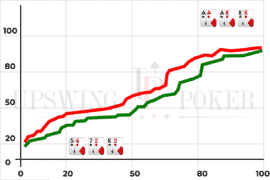
The first chart shows the equity of the theoretically optimal betting range against your range. The second represents the high-equity betting strategy of a risk-averse opponent.
The difference is about 4%. That may not sound like much, but in poker—where small edges compound over time—it’s a massive gap, especially on the flop.
If you’re not convinced, take a look at the effect this equity shift has on your theoretically optimal turn probing strategy:


The first chart shows the theoretically optimal strategy against an optimal flop check-back range. The second shows the optimal strategy against the weakened, risk-averse check-back range.
There’s a lot happening in these two images, but two points stand out:
- Increased aggression frequency
- Increased aggression amplitude (larger bet sizes being used)
Every made hand gains in value. Top pairs are upgraded from block-bet value hands to medium- and even overbet-worthy value hands. 8x now bets much more often, and even hands like 44–77 are considered strong enough to block-bet for value.
Keep in mind that in this model, the Button is still defending as well as possible with a handicapped range, avoiding excessive folds. Real risk-averse players, however, not only play the flop too strongly but also tend to over-fold when facing aggression.
For example, here’s how the solver defends against a block-bet:
We see hands like K9, KT, and KQ continuing at a high rate. That’s not consistent with the usual risk-averse player profile. So what happens to our optimal strategy if our opponent folds those hands against a 33% pot bet?

The solver responds with a full range-bet strategy. Why?
The reason is two-fold:
- The Button over-folds significantly (5–6%), which incentivizes bluffing with any non-made hand.
- The Button’s raising range is too strong, making life easy for thin value hands like pairs. Many of these hands can then barrel thinly for value on a variety of rivers.
Remember how I said earlier that when your opponent checks back, it’s a great opportunity to generate extra EV? Here’s the proof.
In the GTO model, the solver generated 28.8 chips (with the big blind set at 10 chips) after reaching the turn following a flop check. In our exploitative model, that number jumps to 35.9 chips. That’s an extra 71bb/100 in expected value—a massive gain that almost everyone misses.
Wrapping Up
That’s all for the first part of this series (read part 2)! If you enjoyed the article, let me know which type of opponent you’d like me to cover next. Should I dive into the trickster, the reckless player, or someone else entirely? Share your thoughts in the comments below.
Until next time—good luck at the tables, grinders!
Want to learn how to play tricky spots after check-raising flops? Read: How To Play Overcard Turns After Check-Raising the Flop.