Check or Bet? How to Build Strong Flop Check-Back Strategies in Tournaments
Let’s face it.
Checking back stinks, doesn’t it?
It can feel even worse than folding — the most cowardly act in poker.
At least when you check-fold, you never had the betting lead to begin with.
Here, though? You talked a big game with your open-raise, only to start backpedaling once the flop hits.
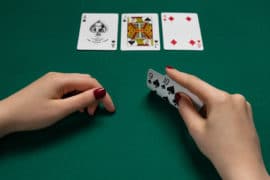
You glance at your opponent, a stone-faced Scandinavian. You glance down at the 7d 7c 6c flop. Then you glance back at your As Td.
You don’t want to bet for fear of a check-raise.
You don’t want to check for fear of a turn lead.
“What would Phil Hellmuth do?” you ask yourself. “He’s the GOAT… me? I’m just a bum.”
In today’s article, I’ll give you the tools to handle uncomfortable boards as the preflop raiser.
What you won’t learn here is how to silence negative self-talk or build the inner resilience needed to crush poker at the highest levels — that’s a job for your therapist.
But when it comes to equity disadvantages? This article has you covered.
Here we go.
The Basics of C-Betting
Before you can understand when to check back the flop, you need a firm grasp on continuation betting.
A long time ago, before the age of solvers, c-betting rose to popularity for one simple reason: it worked. Some sharp minds of that era had already figured out why it worked, but most players believed it succeeded because the preflop raiser had the “betting lead.” Concepts like “playing in flow” spread through the poker world, with the idea being that whoever started telling the story got to keep telling it.
Today, solver outputs confirm what those early players sensed. Their logic was crude and incomplete, but the fundamentals were surprisingly close to the mark.
The Main Drivers of C-Betting
(Hint: It’s not betting lead)
If c-betting were only about maintaining the betting lead, you’d never check back. The fact that solvers do check back proves that while “betting lead” can be tactically functional, it isn’t the real driver.
C-bet frequencies hinge on two things:
-
Range Advantage — whose range has more overall equity.
-
Example: Button opens, Big Blind calls. On Ks 7c 3d, the Button holds more strong hands (best Kx, AA, top set), while the Big Blind has many weaker hands (small pairs, suited connectors, etc.). Overall, the Button’s range equity is higher — this is range advantage.
Importantly, “strong” is defined by board texture. So it’s not just range advantage that matters, but also nut advantage.
-
-
Nut Advantage — whose range has more of the absolute strongest hands.
-
Example: On 8d 7d 6d, the Big Blind (caller) has far more flushes and straights, while the Button (raiser) has relatively few. Even if the Button owns a slight range equity edge, the Big Blind controls the nutted hands most often.
-
Yes, you may have more overpairs and top pairs in your range, but remember: No-Limit Hold’em is a five-card game.
Note: For some readers this may feel basic, but it’s essential groundwork before we dive into the good stuff. Stick with me.

Checking Back is About Respect
If you followed the last section closely, you may already sense the real driver behind check-backs: respect.
Not respect for the person — though you should respect every opponent, even the so-called villain — but respect for their range.
Respect means recognizing when your opponent’s range is dense with strong hands and natural high-equity continues. In those cases, you check more often. The textures that demand this respect are easy to spot: low, connected boards where the Big Blind’s range interacts heavily — think 6h 5c 4s rainbow, 7d 7s 6d with a flush draw, or 8c 6c 5c monotone.
That said, this isn’t black and white. Some boards you c-bet almost every time. Others you check almost every time.
Most of the time, though, the optimal strategy lies somewhere in between. It’s about frequency.
Now that we’ve cleared the theory, let’s get into the nitty-gritty with a real example.
The 6h 5d 4c Example
You open from the Lowjack with 40bb. The Big Blind defends.
The flop rolls out 6h 5d 4c. The Big Blind checks.
What’s your move?

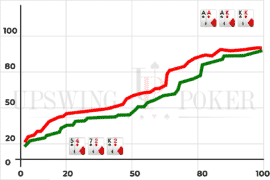
Lucid GTO cEV 40bb, LJ v BB: LJ strategy facing BB check on 654 rainbow. LJ checks 53% of their range and c-bets large 47% of the time.
Red: Bet, Green: Check.
Here, the LJ strategy mixes their actions, with the predominant one being to check. To understand what part of the range wants to check, first look at what the solver wants to bet with.
-
Top of Range: Straights, sets, and two-pair combos. Strong enough to face a bad runout or some aggression from the BB. Betting these provides the framework for everything else.
-
Vulnerable Value: [88]–[JJ]. Hands where equity is peaking on the flop and whose destiny is severely impacted by the runout.
-
Strong Draws: Hands that can face BB aggression now and benefit from playing many kinds of runouts but have no showdown. High-equity bluffs.
-
EV-Floor Unpaired High Cards: Here, hands like [A9o], [KTo], [QTo], and [JTs]. These hands are low EV relative to what’s available in range, lack playability, and have limited ability to improve. Their showdown value is also highly sensitive to runouts. There are too many of them in range to bet every time, but they’re necessary as present and future bluffs for balance.
Once you see this, developing a check-back range becomes a little easier. It’s obvious to say, but you check back hands that don’t benefit from betting. On low boards, the burden of checking back will usually fall on your best Ax and broadways (the ones with a backdoor flush draw are nice). These don’t want to bet-fold, and while some can withstand a check-raise, putting yourself in a spot where you are bet-calling too often with them can get expensive.
To keep the BB from getting out of line when you check back, the solver mixes in 7x (A7s, K7s, 97s), 98s, and sometimes sets or two pair (76s), along with premium overpairs (AA, KK). Chances are you already check back hands like AK, KQs, KK, and AA. The adjustment is simply to add in those draws and stronger combos.
Playing this way means you still have strong hands and potential nuts on future streets when the runout invites BB aggression. That prints when your opponent makes the mistake of disrespecting your range.
Even in theory, respect is a two-way street.
When to Check Back More than GTO
Are you surprised at how high the c-bet frequency is in this example? LJ is supposed to fire 67% pot 47% of the time.
“I thought this article was about checking back…”
Leading Ranges Impact C-Bet Strategies
In the above output, there’s a slight preference for checking back (53%). That might not seem like much, but it’s due in no small part to the BB’s failure to lead.
Take a look.

Lucid GTO cEV 40bb, LJ v BB: BB strategy on 654 rainbow as first to act.
Red: Bet, Green: Check.
Here, you can see that the BB should aggressively lead this board (65% frequency — 435 of their 671 total combos), leveraging their top-end advantage. They have a lot of 6x, two pair, sets, and straights. They even hold some overpairs ([88]–[99]). Even their bluffs, like unpaired 7x, carry plenty of equity (for example, Qh7h worth 3.25bb).
Because this solution was set up to include leading (donk bets), when the BB does check, they have fewer of their strongest combos. That’s why the LJ checks less often here than you might otherwise expect.
So what if your opponents don’t lead?
Pay attention to them. Are they leading boards that favor them, like this one? If so, replicating a Lucid-style strategy will perform well. But if they aren’t — and some villains will never lead flops from the BB — then even though the solverland strategy checks back 53% of the time, you’ll be better off upping your check-back frequency on these boards. You wouldn’t be far off simply checking back most of the time.
Tips for Exploiting Flop Leads (or the Lack Thereof)
The inclusion or removal of flop leads creates plenty of room for mistakes — and therefore, exploitation. If you notice an opponent leading low boards, pay attention to whether they’re weighted toward value or bluffs. Nailing frequencies in these spots is tough, and most players will lean too far in one direction.
-
If you play online: check your HUD for elevated RFI, c-bet, 3-bet, and flop check-raise stats. If your opponent tends toward aggression, chances are their leads are overweighted to bluffs since they won’t have strong hands often enough to back up their aggression. This allows you to slowplay your best hands, or 2-bet using a hand-vs-range framework (e.g., they lead on 6h 5d 4c, you 2-bet [A6] for value/protection, or you rebluff with [K7s], which is ahead of their bluffs and still has equity versus real hands).
-
If their stats skew passive: expect a higher density of nutted hands. In those cases, get out unless you have strong ways to improve or are already nutted yourself.
-
If you play live: you don’t have a HUD, but you do have the advantage of single-tabling and observing every detail. Apply the same logic — and remember, it’s rarely good news when the OMC suddenly decides to lead.
-
If your opponents aren’t leading at all: be careful with your c-bets. In the above example, betting 47% with a large size would be too frequent. On low, connected boards (9 or under), especially with a flush draw present, you should check back more often. Otherwise, your opponent retains all the hands they were supposed to lead with, which means they can punish you with higher-frequency check-raises or call-flop, donk-turn lines.
Summary
Developing check-back strategies is actually quite simple once you understand what drives your c-betting. When your opponent has both a range and nut advantage, you should check more often. This is especially common on low, connected board textures where your range is heavy on high cards and the Big Blind’s range interacts more directly.
When studying solvers in these spots, be careful not to blindly follow the outputs. If the Big Blind doesn’t lead on “their” boards, the checking frequency for the initial raiser will naturally increase since the Big Blind retains all the hands they should have led. If the Big Blind does lead, make sure your check-back range includes more than just high cards and overpairs. Mix in combos that can improve on future streets.
Good luck.
Want to learn how to maximize your MTT wins with postflop aggression? Read: This Greedy Value Bet Strategy Will Help You Win More Tournaments.