Outplaying the Reckless Player: Mastering Turn Probes After Missed C-Bets
In the first part of the series, I covered the most common opponent type – the risk-averse player profile. In the next part of the series I am going to cover another common opponent type – the reckless player.
Let’s dive in!
High-level View – The Reckless Player
The Reckless Player
I define the reckless player as someone who lacks a calibrated understanding of risk versus reward—and how that ratio governs a poker game. As a result, they over-invest their equity at nearly every point in the game tree.
They do this for a mix of reasons:
- A higher pain threshold for losing. Studies show that the average person feels about twice as much pain from losing an amount of money as they feel pleasure from winning the same amount. The reckless player’s pain ratio is closer to 1:1. They simply don’t feel losses as sharply, which leads them to take more marginal or outright bad risks.
- A stronger dopamine response to winning or nearly winning. This type of player gets a bigger chemical reward from the thrill of victory—or even the possibility of it. That makes them more likely to chase draws, call light, and bluff-catch in spots where others would fold.
- Weak fundamentals. Often, they just haven’t studied enough to understand what a sound strategy looks like. They’re adrift on a raft in the middle of poker’s turbulent ocean—no compass, no map, and no way to course-correct.
This profile is far less common than the risk-averse one, and for good reason: it’s a losing strategy in the current ecosystem. The reckless player’s style is naturally exploited by risk-averse opponents—the very type they’ll face most often. What feels like courage or confidence in the moment usually translates to consistent over-investment and long-term loss.
Playing Out the Scenario
Let’s play out a simple example to see this concept in action.
You have one player whose strategy is to bet almost exclusively with high-equity hands—top pairs and better, plus strong draws like gutshots and above. His opponent, on the other hand, loves to call with nearly every pair, plus plenty of pretty-looking hands such as two overcards, Ace-highs, and gutshots—even when the board is terrible for them.
One player is leveraging money when he has a high chance to win the pot.
The other is doing so with a low chance to win the pot—and worse, with a chance that’s lower than his pot odds justify.
Run that matchup over a million hands and the result is inevitable:
the first player slowly, methodically ends up with all the money.
It becomes obvious that this kind of reckless, low-equity strategy can’t win long-term. Players who operate this way don’t evolve into professionals—or even consistent semi-pros—because their entire approach bleeds EV every time money goes in.
So Playing Risk-Averse Is the Optimal Strategy, Right?
The simple answer: No!
I intentionally left out a few details earlier to build some curiosity and set the stage for this next point.
The main reason the reckless player is naturally exploited by the risk-averse player mostly comes down to preflop. Reckless players over-invest in spots where folding would have cost them nothing—situations with zero expected value loss. Every time they take a marginal hand and push chips into the pot instead of folding, they’re leaking money before the real game even starts.
Postflop, though, things get murkier. The battle between the average risk-averse player and the reckless player is much closer to even. The reckless player wins their fair share of pots by bluffing the risk-averse player off hands, while the risk-averse player wins theirs by value-betting the reckless player into oblivion.

It’s a tug-of-war between over-bluffing and over-folding—each side exploiting the other’s extremes.
Before diving into the details of our main topic, let’s first outline how a risk-averse strategy typically manifests. We’ll revisit and upgrade these tendencies after we dig deeper into what’s really happening in the following sections.
Here’s what that strategy often looks like:
- Over-probing for value. He probe bets slightly too often with made hands compared to GTO, which would protect its checking range more carefully.
- Over-probing with draws. He fires too frequently when holding strong draws, turning them into unnecessary bluffs.
- Under-probing with weak draws. He fails to pull the trigger with non-strong draws like two overcards, missing good semi-bluff opportunities.
- Over-folding after checking. Once he misses a turn probe and faces aggression, he check-folds too often instead of defending at an appropriate frequency.
These small deviations might seem harmless in isolation, but together they form a predictable pattern—one that the reckless player can occasionally exploit, and one that the disciplined player can exploit consistently.
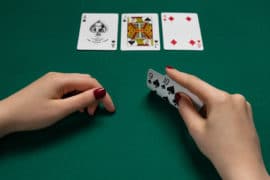
With that groundwork laid, let’s model our reckless player using the same situation as before: you’ve called from the Big Blind against a Button open-raise, and the flop comes Js 8s 3d.
Before we go deeper, there’s an important point to clarify.
This player type’s flop c-betting strategy often looks surprisingly close to GTO. That might sound counterintuitive, but it makes sense once you realize that GTO has no built-in risk-aversion bias. It mixes in certain “random” frequencies—perfectly calculated within equilibrium—that happen to resemble the reckless player’s actually random strategic choices.
Because of that overlap, we’ll skip modeling his flop play and instead focus on his responses to the probe bet and his approach after missing the turn probe bet.
The solver, when modeling this node, chooses a multi-size probing strategy, as shown in the image below:

I will only model the reckless player’s strategy against the two most preferred sizes: the overbet and the block bet.
His GTO defending strategy against the overbet is this:

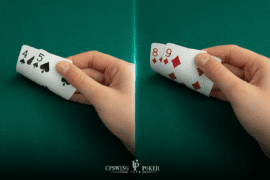
I’ve node-locked his folding range to better reflect what we see in real games. In practice, this type of player rarely folds any draw (in this case, Qd Td and Qs 9s), any pair, any pocket pair above middle pair, or any pair with a spade higher than third pair. I also included a small portion of A-K for good measure.
These adjustments reduce his overall fold frequency from 53% down to 46%, creating a far more realistic defense profile for this player type.
I didn’t alter his raising range, as the available data isn’t sufficient to build high-confidence models for how this archetype raises versus a probe.

Next up, here’s his GTO strategy against the 33% pot probe bet:

And here’s the node-locked version where I’ve only modified his calling range. In this model, I’ve included all Ax hands with two overcards to the middle pair, all Kx hands with two overcards to the middle pair, and all pocket pairs (in this case 22).

The next step is to model his delayed c-bet strategy.
Based on my database analysis, this player type fires delayed c-bets about 6% more often than they should. They also bluff more frequently than optimal—though it’s difficult to quantify the exact margin due to showdown bias—and they size too small too often, leaning heavily toward 33% and 50% pot bets.
Here’s the GTO delayed c-bet strategy for comparison:

Here’s the model I’ve created for him:

In essence, I collapsed the sizings into a single 75% pot option and adjusted his range to include a few too many bluffs—53% of his betting range compared to 49% in the GTO model. I also added a few too many medium-strength hands, another classic reckless player deviation (and a broader pattern among recreational players in general).
Now, here’s the resulting minimally exploitative strategy calculated by the solver:

We can see that the optimal bet sizing collapses into a simple overbet-or-check strategy, and the betting frequency drops from 41% down to just 18%.
Not only that, but the range composition shifts dramatically. In the GTO model, the solver used 66% bluffs within its betting range. In this optimized version, that number falls to 43%.
Now, what I’m about to tell you might shock and even demotivate you at first, but stay with me—I’ll explain why it’s not as bad as it sounds.
The EV increased by just 7bb/100.
I know—that sounds very low, especially compared to the EV gain we saw in Part I of this series.
But there’s a big catch.
Outperforming the Solver
The first thing to note is that, in the risk-averse player model from Part I, I made significant adjustments to the GTO flop c-betting strategy. In this model, I made none.
That makes it the perfect example of how a well-constructed flop betting range can shape your maximum exploitability, and it serves as proof of the principle I outlined earlier:
Playing the flop is the cornerstone of a great strategy—not necessarily because it creates massive EV gains (though it can), but because it prevents you from losing expected value through turn and river exploitability.
However, that doesn’t tell the whole story. The solver has a critical limitation—it automatically recalibrates for the reckless player’s mistakes on the river. This correction effectively saves him a large amount of EV by preventing those errors from happening.
That’s not how poker plays out in the real world, of course—but it’s the best approximation our current tools can provide.
From here, we have to make a mental leap and let bounded rationality guide our understanding.
To help bridge that gap, here’s another key fact: reckless players over-bluff the river by a large margin, and they bet at least as often—if not more often—than they should.
This means that by checking your stronger hands—top pairs and middle pairs that the solver often preferred betting on the turn—you’ll win far more than the solver predicts. You’re capturing additional EV from several sources:
- His over-bluffed delayed turn c-bets,
- His over-bluffed river barrels, and
- His over-bluffed double-delayed river c-bets.
Now let’s talk about bluffing. While the solver did reduce its bluff frequency substantially, in practice, you should take that idea all the way to zero.
Bluffing here is a -EV play. The solver only includes bluffs because it must balance its value range to maintain indifference in the reckless player’s strategy—essentially forcing him to bluff-catch in equilibrium. In reality, those bluffs don’t make money when they miss; in fact, they lose money. And there’s no need to balance your value range to get called, because the reckless player simply isn’t tracking your range composition.
While we can’t calculate the true EV of your turn strategy precisely, the conclusion is clear:
your real-world expected value is significantly higher than the solver’s 7bb/100 estimate.
Summing It All Up
If I were to crystallize this entire article into one golden nugget, it would be this:
Let the reckless player hang himself—and don’t be afraid to call him, especially after he’s shown weakness at any point in the hand.
That’s all for this part of the series!
I hope you enjoyed it and that it opened your mind to a new way of looking at the game—one that helps you make more money by out-strategizing your opponents.
See you in the next part of the series!
Til next time, good luck, grinders!
To read more about how to capitalize on your opponent checking back on the flop, read: Your Opponent Checked Back—Here’s How to Capitalize (Part I).