LLinusLLove vs Kevin Paqué in a CGWC High-Stakes Showdown
We got a blast from the past in this article. Well, it’s not quite so far back in the past, as we are talking about a hand from the first-ever Cash Game World Championship, which took place from early December 2024 to mid-January 2025.
The stars of the show are two of the best: Linus Loeliger (aka LLinusLLove) and Kevin Paqué (aka TaxHere).
The game is No Limit Hold’em, the blinds are $50/$100, the stacks are $17,000 deep, and they will be swapping places!
Did anyone make a mistake, or was it just a cooler? Keep on reading to find out.
Without any further ado, let’s jump right into it!
Preflop Action
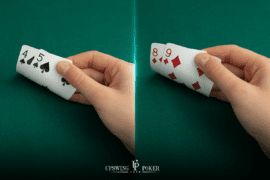
Linus opens the action with a raise to $250 from the Button holding 5h 5d. Kevin defends the Small Blind with Ah Kh by 3-betting to $1,100. Linus calls.
Simple Preflop Analysis
When stacks are deeper (170bb instead of 100bb), the Button should open slightly more hands because having more chips behind increases the value of playable, well-positioned hands.
The raise size stays small, around 2.5bb, to keep pressure on the Big Blind’s wide range.
In response, the Small Blind should 3-bet a tighter, more polarized range, favoring suited hands over offsuit ones.
Facing that 3-bet, the Button still folds most of the time but can profitably call more suited and speculative hands than at normal stack depths.
Both Linus and Kevin played their hands correctly up to this point.
Preflop Analysis
With 170bb effective between himself and Kevin, Linus should be expanding his open-raising range slightly, from the top 44% (which is GTO-approved at 100bb deep with rake, and the CGWC is rake-free) to around the top 48% of hands.
This adjustment happens because, as the player with the range advantage, nut advantage, and positional advantage, you can extract more value and create more difficult spots for your opponent the deeper the stacks are.
Here’s a custom preflop simulation I created for this spot:

A 2.5bb raise size is appropriate in this spot, as you want to create a difficult situation for the Big Blind, putting a lot of his range in close-EV spots. Anything between 2bb and 3bb is going to generate virtually the same amount of expected value. Making it too large makes the Big Blind’s life very easy, as he won’t need to defend with a wide range of hands, which would also make his life easier postflop since he would be holding stronger hands more often.
Keeping in mind that Kevin is deeper and that the game is rake-less, he should start developing a calling range on top of the “standard” 3-betting range.
The most widespread rake rule is the “no flop, no drop” rule, which states that no rake is taken if no flop is dealt. This incentivizes 3-betting over calling, as the former has the potential to avoid the rake penalty while the latter does not. When that “tax” is removed from the EV equation of calling, suddenly calling becomes more appealing.
Calling starts to become interesting for hands such as low pocket pairs when the potential payout is so much higher when hitting a set (or even quads). The same goes for hands like:
- AJo, ATo, KJo, KTo
- low Kx suited
- Q7s, J8s, T8s, 97s
- suited connectors
Because you don’t want your calling range to be too capped with a player left to act who can squeeze you out of the pot, you will also start including traps in your calling range.
The 3-betting range is therefore going to shrink from the optimal 14% frequency at 100bb deep to around 10% in this specific scenario.
As far as sizing goes, anything from 10bb to 12bb works well, putting enough of the Button’s range in a tough spot by giving him very close odds. An argument can be made for using larger sizings when playing deeper, as deeper stacks favor the Button. By raising bigger, you reduce the stack-to-pot ratio and, consequently, the postflop maneuverability that the Button enjoys.
Here’s a visual of the GTO defense from Kevin’s perspective:

Against this 3-bet, Linus should be defending with a wide range of hands, folding around 55% of the time. While the defense frequency is very similar to the one at 100bb deep, it represents more combos because his open-raising range was looser. We will see hands such as K7s, T7s, 86s, 75s, 64s, and 53s becoming flat-out profitable calls.
Another change from the 100bb strategy comes in the form of more calls with hands that are otherwise happy to stack off, such as AKo, QQ, JJ, and TT.
The reasoning behind this strategic divergence is that these hands are not as happy to face a re-raise from the Small Blind when deeper. It’s one thing to get shipped on with 100bb behind; it’s another to do so with 170bb.
Another reason for this adjustment is to protect the calling range from the increased mathematical pressure the Small Blind can apply with deeper stacks. With greater leverage, the Small Blind can attack more aggressively, so by uncapping the Button’s calling range (at least to some degree) it disincentivizes overly fearless aggression and protects the lower hand tiers.
Here’s a visual of the Button’s defense range:
So far, no surprises here; both players played their hands correctly.
Flop Action
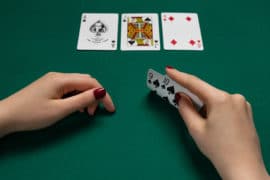
The flop comes Kc Qh 4c, and the pot is $2,300.
Kevin (Ah Kh) bets $700. Linus (5h 5d) raises to $2,500. Kevin calls.
Simple Flop Analysis
Kevin’s range hits this flop way harder than Linus’. As the preflop 3-bettor, Kevin has more strong hands: more top pairs, all the best overpairs, and more two-pair and set combos. Most of his range already has a made hand or a strong draw.
Because of that, Kevin should bet a lot and small — he can value bet many hands and still have enough natural bluffs.
Linus, on the other hand, has to fold more than usual. His good continues are his pairs, his draws, and some backdoor-draw hands. Pocket 5s without a backdoor flush draw (like the 5h 5d he actually had) are simply too weak, even as a raise. It’s a fold in theory.
Flop Analysis
Kevin has a stupendous range and nut advantage on this board. Double-broadway flops will do that for the 3-bettor’s range, as his preflop range revolves around strong pocket pairs, double-broadway combos, and Ax suited. Not only does Kevin have almost twice as many top pairs, but he also has the unique overpair of Aces, as well as an advantage in both the two-pair and set categories.
Moreover, on this specific texture, less than a third of Kevin’s range consists of non-made hands, with only around 12% of his holdings lacking either a pair or a direct draw to a straight or flush.
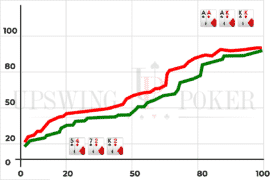
Here’s a comparison between the range compositions of the two players:

In situations like this, when you have a ton of thin value bets available and not many natural bluff candidates, the optimal way to realize your equity is to bet extremely aggressively. Using a small size forces the Button (or in this case Kevin) to continue with weaker hands, which allows you to value bet thinly and bluff with every missed hand in your range.
If you don’t frontload your aggression, the Button won’t do it for you if he’s playing intelligently. He will understand that your range is lacking in air, and that checking means you either have a medium-strength hand, a small amount of air, or some traps. That is not a range he wants to bet into at a high frequency.
Here’s a visual of the optimal c-betting strategy for this spot:

So far, so good for Kevin.
Against this strategy, Linus should be overfolding slightly, and this is simply because Kevin’s betting range contains a lot of thin value and mergy hands that retain significant equity. This means that checking still generates a meaningful amount of EV for Kevin, and Linus is only trying to match that EV, not overcome it.
Linus should be defending with all of his board pairs, his pocket pairs with a backdoor flush draw, and all of his draws. His raising range consists of KQ+ for value, various draws (combo draws, flush draws, and gutshots), some double-backdoor nut draws such as Ah 2h, Ah 3h, and Ah 5h, as well as some merges with backdoor flush potential like A4s, 64s, 54s, and pocket pairs containing a club such as [2c] 2x, [3c] 3x, and [5c] 5x.
Here’s a visual of Linus’ optimal defense strategy:

Nowhere do you see me mention 5h 5d that Linus actually held, because it is a pure fold in theory. Continuing here against a strong player is, as we say, quite torching:

Raising is indeed better than calling, but it still has a loss rate of 87bb per 100 hands.
Not having the backdoor flush draw is key here. Not only does the [5c] block Kevin’s [Ac] 5c and [6c] 5c high-equity continues, but it also gives you an extra boost in both playability and equity.
When the flush comes in on the turn after you raise and get called, for example, you can barrel with the 5c in your hand and bluff Kevin off hands such as AQ with no club, AK with no club, and even AA with no club, while still retaining a substantial amount of equity against his calling range.
Against this raise, Kevin has an easy decision with his specific hand and with most of his range. The threshold hands are pocket pairs with a club, KJo with no club, and gutshots with no club. These hands mix between calling and folding in this spot.

Turn Action
The turn comes the 7h, making the board Kc Qh 4c 7h. The pot is $7,300.
Kevin (Ah Kh) checks, and Linus (5h 5d) checks as well.
Simple Turn Analysis
Kevin’s turn check is good. Creating a small donking range in this spot is optimal, as it would deny Linus the opportunity to check back for free with his draws and would extract value from them.
Linus’ check is a mistake here. Despite his sub-optimal flop line, he should attempt to play the rest of the hand as well as possible. In this scenario, that means continuing to barrel his hand as a bluff (specifically a merge-bet, which we’ll cover in the detailed breakdown).
Kevin’s call is perfectly fine. He doesn’t need to get all the money in before the river, since he is not afraid of the heart flush completing.
Turn Analysis
The turn 7h is a pretty neutral card. It doesn’t improve either player substantially, as the card doesn’t interact much with either range.
On such blank turns, Kevin is incentivized to create a small donking range because he has the range advantage but not the nut advantage. This allows him to value bet thinly while also forcing Linus to put money into the pot with hands that would otherwise be tempted to check back and see the river for free, specifically his draws.
Against a check, however, Linus should start betting with a polarized range for a large size (around 75% pot), looking to get his stack in on the river with KQ+.
He should be going with his hand at this point. Yes, the flop call was a mistake, but he still needs to play the rest of the hand as well as possible to minimize that mistake.
Barreling here with 5h 5d is nice because it will make Kevin fold a lot of better hands (such as 88–JJ with a club, most of his AQ, and the majority of his KJ and KT), while also getting called by a few worse hands such as combo draws (AJs, ATs, JTs, J9s, T9s, 65s) and Ah4h. This is considered a merge-bet.
Checking here is a big mistake in the solver’s eyes:

Checking nets 140bb/100 less than betting 75% pot.
Against a bet, Kevin has a super simple snap-call. There is no reason to raise at this point, since his hand doesn’t suffer from letting Linus see the river. If he had As Ks or Ad Kd, then raising would be the best play, since forcing Linus to put all of his stack in with his draws before seeing the river is a big win.
River Action
The river comes the Ks, making the final board Kc Qh 4c 7h Ks. The pot is $7,300.
Kevin (Ah Kh) shoves for $13,700, and Linus (5h 5d) calls. Kevin scoops the $34,700 pot.
Simple Analysis
Kevin should now put his whole stack in with a super-nutted hand, looking to stack Linus’ extremely weak range. You shouldn’t bet small to get calls in this spot. Even if you get called less often when you shove, the fact that you win so much more makes up for it.
Linus’ call is marginal in theory. His hand doesn’t block any of Kevin’s bluffs, which makes it a good candidate for bluff-catching.
River Analysis
The river Ks is a great one for Kevin. His range absolutely smashes this board, to the point that the optimal strategy is to bet with all of his hands, some as block bets and some as shoves.
Here’s a quick visual of this crazy strategy for effect:
You see, when Linus checks back on the turn, he is hard-capping his range. By that I mean his range becomes either a missed draw or a low pair. In theory, Linus should have some slivers of Kx and Qx of clubs in his range, but I doubt that happens in practice, even at the nosebleed level. That is such a solver play. Just imagine raising the flop with Kd 8d. It doesn’t make sense for us humans.
Against such a range, when Kevin has all the nuts and a ton of medium hands that can extract value from 4x, there are barely enough natural bluffs. This is why we see a range-bet as the optimal strategy.
With AK, you can see that the solver’s main line is to shove. The logic behind it is to maximize your EV against Linus’ bluffcatchers with a hand that has more than 99% equity.
Against the shove here, Linus’ 5h 5d is actually an acceptable bluff-catcher (calling has 0 expected value in theory). The reason for this stems from Kevin’s bluffing range, which does not interact with 5h 5d at all. This means Linus is unblocking all of Kevin’s potential bluffs, which revolve around the Jack and Ten combos (think AJ, ATs, JTs, J9s, T9s, T8s).
It is actually better to bluff-catch with 5h 5d than with 5d 5c or, surprise-surprise, pocket Tens. For reference, bluff-catching here with pocket Tens of the same suits, at equilibrium, would be losing a staggering 2400bb/100 hands.
Final Thoughts
Okay, so even the best blunder. No surprises there! But I wonder: what do you think about Linus’ crazy call on the river? Do you think it was genius at the wrong moment, or just a punt? Let me know in the comment section down below!
That’s all for this article! I hope you enjoyed it and that you learned something from it.
Till next time, good luck, grinders!