Beyond Raw Equity: Unlocking the True Value of Your Poker Hands
If you’ve been reading my strategy articles for a while, you may have noticed that I often talk about realized equity. That adjective is used intentionally, and it makes a world of difference. In this article, I’m going to give you a comprehensive breakdown of what realized equity is, how it differs from raw equity, and, more importantly, how it helps you play better poker.
Let’s dive in!
What is Raw Equity?
Raw equity is the probability that a hand will win at showdown if all the remaining community cards are dealt without any further actions. If the equity of a hand is 50% at showdown, then the pot is chopped.
For example, if you go all-in preflop with Pocket Aces and another player calls with Pocket Kings, there is an 82% probability that you will still have the best hand once the flop, turn, and river are dealt. Therefore, your equity is 82%.
Here is a quick list of how different hands fare against each other equity wise:
 |
Pretty straightforward, right? Now let’s see what realized equity actually means.
What Does Realized Equity Mean?
While raw equity describes the probability that a hand will win the pot at showdown without any further actions being taken by any player, realized equity is the amount of equity that a hand has, which takes into account all the actions that the players will take.
This concept is intrinsically linked with expected value (EV). The equation that describes the amount of equity realization a hand has is:
EQR = EV / (EQ × Pot Size)
Where:
EQR = Equity realization
EV = Expected value
EQ = Equity
And your realized equity is:
RE = EQR × EQ
Allow me to give you a conceptual example first.
You have A7 suited, and your opponent has 65 offsuit. Let’s say the pot is 1.5 big blinds. Your equity in the pot is 64.3% against 65o. If we let 10,000 runouts roll off, your EV will be:
EV = 0.643 × 1.5 = 0.96 big blinds
Which means your EQR would be:
EQR = (0.96 / (0.643 × 1.5)) × 100 = 100%
Now let’s say that if you raise to 4bb, your opponent always folds. Your equity realization when this action is taken would be:
EQR = [(1 × 1.5 – 0 × 4) / (0.643 × 1.5)] × 100 = 156%
And your realized equity will be:
RE = 1.56 × 0.643 = 100%
This is easily verified—since your opponent always folds, you win the pot 100% of the time.
But there are even better outcomes possible than simply winning 100% of the pot.
How could that be?
Let me give you an example. Let’s say you’re heads-up on the flop with two pair. The pot is 5.5 big blinds (2.5bb raise first in, 2.5bb Big Blind’s call, and 0.5bb Small Blind’s investment).
Let’s also say your equity is 85%. Do you intuitively expect to win only 4.675 big blinds out of the pot on average? That would mean a profit of just 2.55bb on average (85% of the other players’ investment).
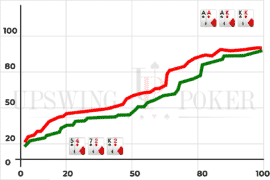
The answer is simple: no. The reason is that the pot will sometimes grow exponentially larger (when you bet and your opponent calls or raises), while your equity doesn’t diminish at the same rate. This creates an asymptotic relationship between equity and pot size.
Here’s a visual representation of that relationship:

In short, winning 85% of a pot that is twice as big (as an example) is far better than winning 90% of a pot that is half the size. This is why your realized equity could be as high as 250% or more.
There are five variables that determine your equity realization:
- Your actions
- Your opponent’s actions
- Your hand’s inherent capacity to hit very strong hands (which stems from probability theory)
- The stack-to-pot ratio
- The rules in place—more specifically, the betting rules
Let’s go over them.
Your Actions and Their Impact on Realized Equity
You may have noticed that there’s a bolded section in the definition of equity that states: “… without any further actions.”
You’ve certainly heard the phrase “Actions have consequences.” That most definitely applies to equity—and its realization.
I like performing thought experiments that stress-test the ideas I’m working with to verify their validity, and I’m going to do the same for you.
More specifically, I like using proof by extremes. In this case, the hypothesis is that both your actions and your opponent’s actions affect the amount of equity you get to realize.
Let’s say your starting equity is 85% (this is roughly equivalent to holding Pocket Aces preflop against a Big Blind defending range versus an open-raise).
Now let’s consider two extreme examples that illustrate how your own actions impact equity realization:
Case 1 – You never bet or raise with a strong hand
If you never bet or raise with your strong hand, you’ll only move beyond the 85% equity baseline at your opponent’s discretion, since you’re never forcing folds or capturing the full pot. Your equity will only exceed 85% when your opponent chooses to bet with a hand that’s worse than yours.
Advanced note: This approach will under-realize your equity against a very passive opponent, since your equity will exceed 85% less frequently. Conversely, it will over-realize your equity against a highly aggressive opponent who often bets with hands that are behind yours.
Case 2 – You always bet or raise with a strong hand
If you always bet or raise with a strong hand, you’ll often make your equity jump to 100% when your opponent folds. Even when you’re called or raised, your equity typically won’t drop far below the original 85%. This means that, on average, your realized equity will greatly exceed the 85% you started with.
This is exactly why game-theory optimal (GTO) solutions tend to play strong hands aggressively more often than not.

Your Opponent’s Actions and Their Impact on Realized Equity
Let’s run the same process for your opponent’s actions, but from a slightly different angle.
Assume you hold a mediocre hand with 35% equity (this is roughly equivalent to an average hand in a Big Blind defense range against a preflop raise).
Case 1 – Your opponent always checks down
In this case, your equity only drops below 35% (all the way to 0%) when your opponent has a better hand. But it jumps to 100% when your opponent has a worse hand. On average, you’ll realize your 35% starting equity.
Case 2 – Your opponent bets or raises extremely aggressive, but in a balanced manner (no over-bluffs but betting too thin for value)
In this case, your equity will often drop below 35% because you’ll frequently be forced to fold. You’ll only have a decent hand about half the time on the flop, meaning you’ll hit 0% equity quite often. Even when you do have a playable hand, your equity won’t exceed the 35% baseline by much (since your opponent is betting with a balanced range) and you’ll still be forced to fold on later streets, again dropping to 0% equity.
Since, on average, you’ll encounter many more 0% equity situations (spots where you’re forced to fold) than >35% equity situations, your realized equity will end up significantly below your 35% starting value.
Your Hand’s Capacity to Hit Strong Hands
Not all hands are created equally. There are probabilities at play that go beyond what’s visible to the naked eye.
So how can we figure out a hand’s capacity to hit a strong hand?
First, we need to define what a “strong hand” actually is. For this, I’ll assume the rules of No-Limit Hold’em apply.
In that case, strong hands include: overpairs, two-pair, sets, straights, flushes, quads, straight flushes, and—finally—the royal flush.
The stronger the hand, the more equity it tends to realize—because it (almost) never folds (it rarely drops to 0% equity) and often makes the opponent fold (capturing 100% equity in the pot).
Back to our original question: how can we figure out a hand’s capacity to hit a strong hand?
I could throw some complex probability formulas at you—but thankfully, smarter people have already done the hard work and built software that makes this information easy to access in a visual format. The tool I often use is Flopzilla. It shows you the probability of flopping every imaginable type of hand strength.
Here’s a visual of that:

Now, there are three ways to hit one of the above strong hands:
- Directly on the flop
- On the turn
- On the river
Some hands have the ability to flop super strong hands; others need to see at least four cards, and some require all five. The fewer community cards a hand needs to make a strong hand, the stronger that hand is in relative terms.
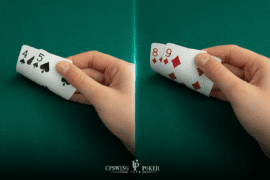
Moreover, while two hands might both have the ability to hit a strong hand directly on the flop, the probability of that happening can differ. For example, 65 suited has a 1.29% chance of flopping a straight, while 75 suited only has a 0.96% chance. This is because 65s can hit four straight-completing flops (987, 874, 743, and 432), while 75s can only hit three (986, 864, and 643).
So, while it may appear that 75s is a stronger hand than 65s (due to the equity it can realize) the latter is actually stronger. This is one of the reasons why 65s is consistently preferred in preflop simulations over the seemingly stronger 75s.
Another major reason for this preference is that 65s is not only more likely to hit a straight on the flop, but also more likely to complete one on the turn.
Let’s take a look at the following comparison:
 | |
75s will have an open-ended straight draw on the flop 7.6% of the time, compared to 9.6% for 65s. In relative terms, this means 65s is 26% more likely to flop an open-ender than 75s—meaning it will also hit a straight on the turn or river 26% more often.
To a lesser extent, the same holds true for gutshot straight draws: 75s has a 14.6% chance to flop one, while 65s comes in at 16.6%.
Zooming out a bit, this same principle is why suited hands are generally stronger than offsuit hands. Check out the statistical breakdown for Q7 offsuit vs. Q7 suited:
 |  |
While these two hands have the same odds of hitting two-pair, trips, a full house, and quads, Q7 suited can also flop a flush—and it will do so 0.84% of the time. This is going to be a nerdy math joke, but that’s infinitely higher than Q7 offsuit (you know, because 0.84 ÷ 0 = infinity). And not only will this happen 0.84% of the time on the flop, but Q7s will also flop a flush draw 10.9% of the time.
This is a big deal, because while Q7 offsuit completely whiffs on a board like Kh 8c 4h, and be forced to fold, forfeiting its non-zero equity—Q7 suited (of hearts) will be able to continue. It retains its equity above 0%, with roughly a 20% chance of hitting a flush on the turn, or even pairing its Queen, giving it more ways to stay in the hand and defend against bets.
The end result of all these probabilities is this: the more likely a starting hand is to make a strong hand (overpair or better), the more equity it will be able to realize. That’s because it will be strong enough to defend against bets, not only preventing its equity from dropping to 0%, but also forcing opponents to fold more often—capturing 100% of the pot and thus achieving higher realized equity.
The Stack-to-Pot Ratio
We’ve established that some hands have a higher capacity to make strong hands than others. Now, I want to introduce a new variable into the equation: stack-to-pot ratio. This variable affects the relative strength of hands, as the upper limit of mathematical pressure a player can apply to their opponent’s range is directly tied to it.
I’m referring to the concept of minimum defense frequency (MDF). Briefly put, MDF is the proportion of a player’s range that must be defended in order to make the opponent indifferent between bluffing and not bluffing. This concept is most applicable on the river, due to several factors that are beyond the scope of this article.
MDF = 1 / (1 + b)
Where b is the bet size expressed in pot-sized bets (PSB).
The larger the bet, the smaller the proportion of your range you need to defend—and vice versa.
For example:
- When facing a 150% pot bet on the river, you need to defend with:
1 / (1 + 1.5) = 1 / 2.5 = 0.4, or 40% of your range. - When facing a 50% pot bet, you need to defend with:
1 / 1.5 = 0.67, or 67% of your range.
When the stack-to-pot ratio (SPR) is small, there’s less room for mathematical pressure. Bets will be smaller, which means it’s nearly impossible to make your opponent indifferent between defending or folding with a hand like top pair. That type of hand will almost never sit on the boundary of an indifferent defense.
Once again, let’s prove this by using extreme examples.
Imagine a spot where the pot is 5 big blinds and the effective stack is 10 big blinds. Even if your opponent shoves for 10bb into 5bb, top pair will almost always fall within the top 33% of your range (1 / 2.5). This means its equity will never drop to 0% before showdown.
Now imagine the same 5bb pot—but your opponent shoves 50 big blinds into it. You now only need to defend with 9.1% of your range (1 / 11). In this case, your top pairs will be much closer to the MDF threshold, potentially forcing them to fold and thus drop to 0% equity before showdown.
The practical takeaway from all of this is:
- The deeper the stack-to-pot ratio, the more important it becomes to have hands that can reach the upper end of the strength spectrum.
- The shallower the stack-to-pot ratio, the more valuable it is to have hands that perform well in the lower end of the strength spectrum.
This is why, for example, in tournaments, high card strength preflop is more valuable than suited connectors or gappers—while in deep-stacked cash games, the reverse is true.
To illustrate this, take a look at the optimal opening range from the LoJack in:
- An MTT with a 20bb starting stack and antes (which incentivize wider preflop ranges),
- Compared to the same spot in a 100bb cash game without antes.
 |  |
65 suited is a pure fold with an EV of -4bb/100 in the 20bb stack scenario (even with the range-expanding ante in play), while it’s a 0 EV raise in the 100bb stack scenario—even without an ante involved.
The Rules of The Game
More specifically, I’m referring to the betting rules of the game. This final point ties together all the variables we’ve discussed so far.
If you’re playing Limit Hold’em, you’re going to realize a lot more equity, since you’ll be facing smaller bets at every stage. These smaller bets apply less mathematical pressure on your hands, meaning your equity will drop to 0% far less often.
The same is true in Pot-Limit games, where you’ll never face the massive 350% pot-sized shoves that are possible in the Cadillac of poker: No-Limit Hold’em.
Wrapping It Up
This is one of the most advanced and densely packed pieces I’ve ever written, so congratulations on making it all the way through. You must be truly passionate about the greatest strategy game ever invented.
I hope I was able to clearly convey the key differences between raw equity and realized equity, along with the underlying factors that shape them. If you have any questions about the material, feel free to leave a comment below—I’ll do my best to answer!
Till next time, good luck, grinders!
If you’d like to learn more about how to use aggression to realize more equity, read: 3 Money-Making Exploits That Work in 99% of Poker Games.