Inside a Championship Hero Call: A Street-by-Street Analysis from the 2025 CGWC
In this article, I am going to break down a big hero call that went down in the 2025 Cash Game World Championship (CGWC).
The featured stars are Biluzin (Brazil), the winner of the 2025 CGWC, and MrLumberjack (USA), who ended up high on the leaderboard as well.
The game is No Limit Hold’Em, the blinds are $50/$100, and the effective stack is just above $15,000.
Was it a good hero call that just didn’t work this time, or was it a punt?
Let’s find out!
Preflop Action
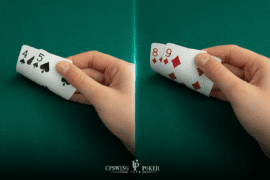
Biluzin opens up the action with a raise of $225 from the Button with 5c 4c. MrLumberjack defends the Small Blind with Ad Ac by 3-betting to $1,100. Biluzin calls.
Simple Analysis
Biluzin should always open-raise with 54s from the Button as it is a hand with a large amount of improvability that also benefits from stealing the pot from better hands quite often.
With pocket rockets, there is no better way to play than by 3-betting from the Small Blind. You want to increase the pot against a heavily dominated range.
Biluzin has an easy time defending with 54s. This hand has a good amount of equity and improvability, flopping and turning flush draws and straight draws often. This coupled with his positional advantage is enough to make it a very clearly profitable call.
The fact that the effective stack size is larger makes calling with this hand even better, as its implied odds are magnified.
Preflop Analysis
Biluzin (5c 4c) should be open-raising with the top 45% of hands. A raise size of between 2 and 2.5bb ($200-$250) is appropriate to put the blinds in a tough spot. 54s is a must-open here.
MrLumberjack (Ad Ac) should be 3-betting with a linear frequency of around 15%. This range should be made up of hands such as
- 55+
- A2s+
- K8s+
- Q9s+
- J9s+
- ATo+, KJo+
- suited connectors
He cannot raise the weaker portion of those hands all the time, but those combos will be mixing raises at low to medium frequencies.
Pocket Aces are a mandatory 3-bet in this spot. This hand wants to increase the size of the pot, given that it’s so likely to win it.
The optimal size is anywhere from 11bb to 12.5bb ($1,100 – $1,250). That size gives Biluzin a tough time with a decent chunk of his range as it doesn’t allow him to flat with too many speculative hands.
Against this 3-bet, Biluzin should be defending with around half of his range, with 54s being a call 100% of the time.
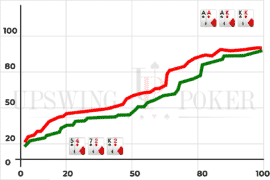
This hand is one of the best Aces crackers, having more raw equity and realizability than even a hand like pocket Tens. To give you some numbers, pocket Tens has 19.2% equity against Aces, while 54s has 21.1% equity.
Flop Action
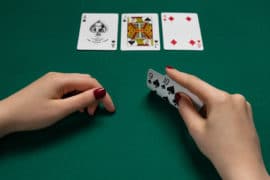
The flop comes Ts 6d 4h and the pot is $2,300.
MrLumberjack (Ad Ac) bets $1,150. Biluzin (5c 4c) calls.
Flop Analysis
This flop favors MrLumberjack’s range. He has the unique overpairs (QQ-AA) and his bluffing range is made up of hands that frequently have 6 outs to a top pair (AK, AQ, AJ, KQ, etc.).
Given that Biluzin has a lot of bluff-catchers and strong non-made hands in his range, the optimal c-betting strategy is an extremely aggressive one, using a larger size (~75% pot).
This strategy extracts maximum value from Biluzin’s rich middle pair, pocket pair, and two-overcard + backdoor flush draws + backdoor straight draws, while pressuring the offsuit overcard region into a 0EV situation (AQo, AJo, KQo, etc.).
50% pot also works well. The important thing to remember here is 75% is better than 50%, which is better than 33%. The latter would give Biluzin too much leeway to realize equity.
Even without a backdoor flush draw, 5c 4c is strong enough to call here as it is oftentimes ahead, and even when it’s not, it still has five outs to a two-pair or trips.

Turn Action
The turn comes the Kd, making the board Ts 6d 4h Kd. The pot is $4,600.
MrLumberjack (Ad Ac) bets $3,450, and Biluzin (5c 4c) calls.
Turn Analysis
The turn Kd is one of the worst possible cards for Biluzin’s range.
This happens because MrLumberjack’s range improves to many top pairs and strong draws. Just think about it. His flop bluffs revolve around the King (AK, KQ, KJ) while the majority of the rest now improve to a gutshot, an open-ender, or a flush draw (AQ, AJ, QJ, Ax of diamonds). This allows him to barrel extremely aggressively, pushing his range advantage. The solver would even bet close to range in this spot, favoring putting money into the pot itself with thinner value hands such as QQ, JJ, and Tx instead of polarizing.
This strategy works best because a strong opponent would respond by checking back a lot and realizing equity for free against a more polarized double barrel strategy.
In this spot, MrLumberjack should start merge-betting with hands such as 88, 77, and 55. These hands can fold out slightly better hands like 99-77 while getting called by Biluzin’s open-enders, flush draws and combo draws.
There is not a single, clear bet size to use in this spot and that is because there are a lot of different hand classes that desire to achieve different goals:
- A hand like AK desires to bet 75% pot as it wants to extract value from KQ and lower.
- A hand like QQ desires to bet 50% pot as it tries to extract from Tx and weaker while not losing as much vs Kx. Betting bigger would isolate it more often against a stronger hand.
- Finally, a hand like KK wants to bet smaller, like 25-30% pot, to incentivize Biluzin to continue with a weaker set of hands, as he’s blocking the top pairs. This would allow him to sometimes set-over-set a hand like pocket Sevens.
Faced with this big double barrel, Biluzin is in a tough spot. He is losing to MrLumberjack’s merge-bets, and even his other bluffs have a ton of equity against it (10 outs or more).
One nice thing about Biluzin’s hand is that it has high implied odds. This happens because hitting the 5 or the 4 on the river is quite disguised and happens to miss a lot of MrLumberjack’s bluffing range. This can lead to a situation where the Small Blind will triple barrel with too many bluffs precisely when Biluzin improves.
These implied odds, especially from a practical perspective, are good enough to push a 0EV defense in theory towards a pure call in practice.
River Action
The river is the 3h, making the board Ts 6d 4h Kd 3h. The pot is $11,500.
MrLumberjack (Ad Ac) shoves $10,000, Biluzin calls. MrLumberjack wins the $31,500 pot.
River Analysis
The river 3h is a brick. It’s not a horrible card for MrLumberjack’s range as Biluzin’s range doesn’t improve much.
His thinner value hands (K9s+) remain strong enough to value-bet.
The solver likes to trap a bit as well with hands such as KTs and TT. This works in theory because of the intense blocker effects against the calling range, Biluzin’s wide non-made hand region, and, perhaps more importantly, how thin the solver is willing to go for value. More specifically, the solver would shove ATs and even some QTs against a check in this spot. This type of play is extremely player-dependent, which makes trapping here questionable in practice.
These non-made hands include combos like QJs, 9d 8d, 9d 7d, and 87s, and he needs to be careful with how often he fires through with hands such as AJ, QJs, Q9s, J9s, and missed flush draws/combo draws. AQ should always be checking here as it has some showdown value, despite also having the best blockers.
Against this shove, Biluzin has a pure bluff-catcher. His only concerns at this point are:
- How often MrLumberjack follows through with his bluffs vs how often he slow-plays with hands like AA, KK, TT, and KTs;
- How his blockers affect that range.
His blockers are quite neutral here. The worst 54s hand to hold would be 5d 4d, as that hand blocks Ad 5d which would be a great bluff candidate. In these tight range spots, blockers have a material impact on the bluffing frequencies.
Final Thoughts
This type of scenario is where the EV is found at the upper limits of the game. It’s these hands that make no money in solver-land that these players can turn into profitable decisions by finding holes in their opponents’ strategies.
Was this a good hero call or a bad one then? The one thing that we can say with a high degree of certainty is that he took an exploitable line.
This is because he called with a hand that almost always ends up folding in theory. That being said, trying to exploit a player automatically opens you up to being exploitable. There is no way around that, and there’s also no way to become the Cash Game World Champion without being willing to take risks by straying off the solver path.
That’s all for this article! I hope you enjoyed it and that you learned something new from it! If you’d like to see more breakdowns from the cash game world championship let me know in the comment section down below!
Till next time, good luck, grinders!
To learn more about how top pros 3-bet preflop, read: Mastering Preflop 3-Bets: Value, Bluffs, and Exploits.