When Betting Bigger Is the Solver-Approved Play In Tournaments
Big hand. Big bet. Usually.
In the pre-solver era, continuation betting for half pot was fairly common, if not the norm.
It’s the early aughts of the new millennium. A young Romanian breaks onto the scene with a new strategy for No Limit Texas Hold’em poker tournaments: a silly, gambly variant of the game. He coins a name for his approach, “small ball.” In a format where players opened for >4x and c-bet for 50% pot, he min-opens and c-bets smaller, reminiscent of the variants that used to rule the day.
Daniel Negreanu’s strategy becomes popular. Small sizes become the new normal.
Ok. Fast forward.
It’s the early 2010s. The poker world sees the nascency of the solver era. A preference for a small ball-like strategy is the new meta. You really don’t want to bet chunky sizes all the time because that’s a very expensive way to play. But there’s more.
Large sizes are making a comeback.
For a minute, using a larger c-bet size was a telltale of what poker generation you were from: unsophisticated street poker. Now? It has worked its way into the meta, a result of being solver approved, or in some cases, preferred.
Ready to learn how the pros deploy big c-bets?
Let’s begin.
What is a Big C-Bet and Why Even Use It?
IMO, a big c-bet is anything greater than 50% pot. Others might disagree and draw the line at 67% pot, 75% pot or 83% pot.
It doesn’t really matter.
What matters is whatever your opponent’s range is doing when they choose not to range-bet (i.e. 20%, 25%, 33% pot).
Larger bet sizes signal increased range polarity.
That just means less middling combos.
Preflop, a polar range is a little more static. Your best hands like AA and KK are balanced against Ax and Kx trash. It will generally be something like that.
Postflop, a polar range isn’t static at all. What makes it into a postflop polar range is going to be determined by board texture.
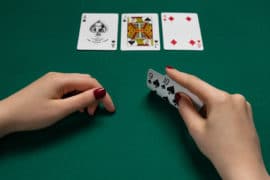
For example, let’s say you’re dealt As Ac and the flop is 9h 8h 7d.
Do you really want to make the pot bigger with your hand?
Probably not.
Instead, you’d rather use a hand that connects well with this board or is at least competitive with your opponent’s continuing range.
Why You Can’t Just Range Bet
C-betting for a small size is usually pretty good.
It’s cheap, which means you should get to use all the hands in your range.
Your strong made hands ensure getting called since small bets invite wider calling ranges. Conversely, your air and draws benefit from cheap auto-folds.
Take the A72r board.
You open. Big Blind calls. You c-bet small (25-33% pot).
- Your Ax captures a bunch of weaker made hands (your A9o vs their A4s, 87o, 55).
- Your bluffs fold out some better unmade hands (your 89s vs their Q5s).
It’s clean, and it works.
C-betting for a small size is pretty good on many flop textures.
But not always.
While small c-bets are very efficient, there are many situations where using a smaller c-bet size really only benefits your opponent. And we ain’t about that.
Let’s talk about some of those instances.

When Runouts Shift Equities
A simple way of understanding equity shifts is that at least one of the players in the hand benefits from seeing all five cards and will do their best to do so. In some cases, the effects are one-way and in others two-way, depending on the type of board and the ranges involved.
When talking about equity shifts, dynamic boards (often called “wet”) come to the forefront of our imagination. These are boards where there is a lot going on. A combination of high one pair interaction and a multiplicity of draws, flushes, straights, present in one or both ranges.
Let’s look at a couple of examples.
Example 1. BTN v BB 50bb effective on 876r.
You’re on the Button. You open-raise to 2.2bb. Big Blind calls.
The dealer lays out a 8s 7h 6d board.
What happens to your range on turns?
When you have an overpair, a T, a 9, an 8, a 7, a 5, or a 4 are all problematic. That’s 23 of 47 remaining cards. If you bet small, BB gets to continue with all these. Their range will improve around half the time on the turn.
Let’s take a look.

Lucid Poker – 50bb effective. BB range facing BTN 33% pot c-bet on 876r. BB continues with all draws.
Here, when you bet small, you let your opponent realize equity with a large chunk of their range. This isn’t ideal when you’re holding a hand like QQ.
The small size is problematic for high equity hands in your range. And this is reflected in Button’s use of the small size (33%). It occurs 1% of the time, which is just solver noise.
Now let’s say you used the preferred 75% pot size. What happens to Big Blind’s range?
See below.

Lucid Poker – 50bb effective. BB range facing BTN 75% pot c-bet on 876r. BB continues 20% more than when facing the 33% size.
Facing the larger 75% pot c-bet, Big Blind’s fold frequency increases by ~42%.
Big Blind folds their bottom gutshot straight draws, some bottom open-ended straight draws, some 6x (bottom pair), and their worst 7x (middle pair). Here’s a key point: equity denial matters.
A counter-intuitive reality is that sometimes the best hand benefits from scaring some hands away. Isn’t it better to get value from everything worse? Not quite.
Locking in your opponent’s top of range and high equity calls is enough of a win since these can stack off. Big c-betting is about getting max from the right hand classes as well as equity denial.
The concern is not the 4-outer of Big Blind’s 4x combos but the lack of visibility on future streets. Folding out their 4x is a good thing, sparing you the frequency where future runouts make your QQ fold. Hands like your A8s experience this same vulnerability, playing similarly.
When you’re ahead now and the future is uncertain, big bets are a good idea.
Now that’s a wet (ish) board. You can infer how making it a flush draw board would increase Button’s aggression with their fragile combos.
What if we use a drier board?
Example 2. BTN v BB 50bb effective on 742r.
Let’s say you’re on the Button and open-raise. Big Blind calls.
The flop is dealt.
7s 4h 2c
Your opponent checks. What should you do?
Take a look.

Lucid Poker – BTN v BB 50bb effective. BTN strategy facing BB check on 742r.
Notice that again, there is no small betting.
Big Blind checks. Here, the solver prefers a large 75% pot c-bet or check.
But isn’t this a dry board? Why not just range c-bet?
On the one hand, you have all the overpairs and are trying to get maximum from Big Blind’s most viable continue: their 7x.
On the other hand, you have a lot of overcards that can pressure Big Blind’s ace-highs and hands that would make it to the turn, were it not for your size.
You’ll use hands like J8s, 98o, and Q9s. These fold out Big Blind’s higher ranking unpaired combos. Here, defensive aggression gets activated.
Big Blind’s strong 7x aren’t really interested in seeing another card.
Right now, the equity of Big Blind’s strong 7x is peaking. All your bluffs can improve and kill their hand (8-Q on the turn or river). What does Big Blind do?

Lucid Poker – BB v BTN 50bb effective. BB facing BTN 75% pot c-bet on 742r.
They check-raise these for a combination of value and protection.
In this instance, the equity shifts will be unilaterally in favor of your Button range. Big Blind uses defensive aggression to deny equity and secure theirs. For this reason, you should put your overpairs to the 7 in the big bet bucket. These will lock in Big Blind’s 7x stack-offs while also denying the equity of their two overcard combos which can pick up a backdoor straight or flush draw.
Here, there is a point about our poker parlance that needs to be made. Solvers don’t think in terms of dry or wet boards and runouts.
In the previous example, you saw a situation where the equity shifts were two-way. Both ranges had top pair. Both ranges had straights. Both ranges had a lot of draws. This created a perfect storm of action. The script can be flipped at the turn of the next card in favor of either player.
In this instance, equities only move further in your favor. Right now, the opener’s range has an advantage and future cards will mostly only extend that advantage.
When your opponent will fold a lot and their immediate stack-off combos will be compromised by future runouts, using a big c-bet is a good idea.
A Basic Summary of Big C-Bet Range Construction
When the solver uses a larger size, there are four common hand classes built into it. This is not exact or exhaustive but hopefully comprehensive enough to help you work it out in real life.
- The Nuts – Ts 9s on 8h 7d 6c
On dynamic textures, betting big with the nuts is essential. The key is that your opponent’s range includes hands that are drawing to the nuts. In general, when signaling a stack-off, you want to have nutted combos that can hold against your opponent’s second-tier strong hands and draws. Excluding top-of-range from your large c-bets on wet boards is asking for trouble.
|
Lucid Poker – Combo frequency view for T9s on 876r, CO v BB 50bb effective |

- Vulnerable Value – Jd Jc on 9s 7s 4h, 8s 8c on 7d 5h 3c
Vulnerable value looks to get stacks in as soon as possible. This ensures your opponent’s made hands have the opportunity to get all in on the flop or on the turn before scare cards give them an exit. Conversely, it ensures getting paid by all your opponent’s draws before they brick or you see a bad card and second-guess.
|
Lucid Poker – Combo frequency view for JdJc on 9s7s4h. CO v BB 50bb effective. |
Lucid Poker – Combo frequency view for 8s8c on 7d5h3c. CO v BB 50bb effective. |


- Efficient Good Draws – 6s 5s on Js 8c 7d
Efficient good draws are a double-edged sword. On one side, they are equity driven – able to make a strong hand – and the large bet works to help them get to the river. Applying a large bet with them also denies the equity of better draws (K9, T6), better unmade hands (high cards like KQ), and even better made hands (7x).
|
Lucid Poker – Combo frequency view for 6s5s on Js8c7d. BTN v BB 50bb effective. |

- Efficient Bluffs With Backup – 9s 8s on 7s 4d 2c
Slightly different from the 3rd hand class, these do not draw to near-nut hands. However, they are equally efficient in folding out better. For example, 9-high bluffing folds out villain’s T-high and better.
When your opponent calls with their weak top pairs, 66, 55, 4x and 2x, a hand like 98 can make a better pair and win. If they have a set, you can turn a flush draw or a straight draw and see a river. You also monetize your opponent’s flop call, turn fold range; a formidable result for hands like 9-high.
|
Lucid GTO – Combo frequency view for 9c8c on 7s4d2c. BTN v BB 50bb effective. |

Big c-bets are all about equity.
Getting the max, protecting the most and denying the most. This is a true enough oversimplification. Use it.
Good luck, Soldier.
Still lost? Right now, you can get Lucid Poker for free. Sign up today and drill these big bet spots!
To learn more about selective betting, read: 3 Reasons Solvers Check Top Pair Out of Position in Tournaments.