3 Reasons Solvers Check Top Pair Out of Position in Tournaments
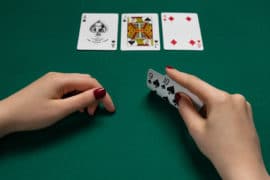
You flopped a pair.
In fact, the strongest kind. Even the highest ranking.
Now it’s time to work out exactly how you’re going to get money in the pot.
Bet, bet, bet? Sometimes.
Did you know that solvers like to check a flopped pair of aces? In today’s article, I’m going to show you when, why, and how to apply it in real life.
Reason #1 – You Are Out Of Position

Lucid GTO strategy for In-Position Player – CO v BB 50bb effective, single-raised pot on A72r (Left). EVs for each possible action of A3s (Right). A3s with no backdoor flush is worth near the total pot (5.9bb) while the backdoor flush draw variants are worth more than the pot.
In the above chart (top left), you can see that the Cutoff doesn’t play any checks. Range advantage plays a factor here. This strategy is heavily driven by the top pair representation of the preflop aggressor (PFA).
See that even the worst Ax combo in Cutoff’s range (right side) – Ac 3c (top pair, worst kicker, no backdoor flush draw) is worth near the pot in expected value (EV).
The backdoor flush draw variants? Worth more than the pot.
Remember, this is for your bottom of range Ax (so the worst Ax hands you have).
As your kicker improves, so does your EV. However, where the EV of a hand like A3s is equal whether betting or checking, the stronger your kicker, the more you want to bet. A hand like AK makes more as a c-bet than a check.
Now this is an article about checking top pair, not c-betting. But understanding the rationale for the latter helps to make sense of how the former works.
It might seem rudimentary to talk about in-position (IP) c-betting with top pair on a dry A-high board in a 2025 strategy article but there’s a reason for its inclusion.

When playing IP as the preflop aggressor, the burden is on you to put money in the pot with your value and balances.
Since your opponent is playing a condensed range, they will naturally defer to you. Range c-bets leverage this by baking in the rest of the PFA’s range. Like two truths and a lie, the stronger parts of Cutoff’s range are used to make their middle and bottom of range perform more efficiently. For example, Cutoff’s Q6s (unpaired high card) is worth just under half the pot in a situation where ~35% of Big Blind’s range is a made hand. What does this mean?
Being in-position benefits your equity realization.
Now you can start seeing why being out of position (OOP) might incentivize checking.
Playing out-of-position puts you at risk of compromising the equity realization of the middle and bottom of your range.
For reference, let’s compare Q6s IP and OOP.
|
(Lucid Poker) CO v BB (IP) 50bb effective. EVs of each action with Q6s on A72r. |
(Lucid Poker) CO v BTN (OOP) 50bb effective. EVs of each action with Q6s on A72r. |
|---|


Above you can see how drastically position impacts the EV of your bottom of range. When IP, Q6s is worth at least 2.1bb. OOP? It maxes out at 0.71bb.
Think about why this is.
When you are IP versus a wider range, you could range c-bet quite efficiently. In fact, Big Blind is folding to a small c-bet 46% of the time. OOP, if you c-bet, Button continues 83% of the time. This is good news for the top of your range but bad news for the middle and bottom.
Being OOP hurts the efficiency of the second and third classes of your range.
Hands like KK, QQ, JJ, T7s, and 33 don’t really want to make the pot bigger versus someone who can fully realize their equity by playing IP. These would much rather check. But you also don’t want to have a range so face-up that your opponent can just pile chips into the pot to pressure folds from these types of hands in your range.
So what do you do?
You check strong hands too.
In the same way you leverage the strong hands in your range to c-bet at a high frequency in-position, you leverage the strong hands in your checking range to limit the efficiency of your opponents’ betting strategy facing your check.
But there’s more to it than that.
Reason #2 – Your Opponent Has A Lot of Their Own Top Pair Hands
It’s not just about the densities of your range but the densities of theirs.
When playing IP versus the Big Blind, you will naturally have a top pair and nut advantage since some of their combos would have 3-bet preflop (AQ, AK, AA etc). This fact aids the IP player’s case for range c-betting.
But an IP flatting range is different.
Let’s compare Big Blind’s defending range and Button’s flatting range versus Cutoff’s open-raise.
|
(Lucid Poker) BB facing CO open-raise 50bb effective. Green: Call (65%), Red: 3-bet (12%), Blue: Fold (23%) |
(Lucid Poker) BTN facing CO open-raise 50bb effective. Green: Call (18%), Red: 3-bet (11%), Blue: Fold (71%) |
|---|


Notice how much wider Big Blind’s calling range is: 65%.
On the other hand, Button’s range is a lot tighter and stronger: 18%.
On the offsuit Ax side, Button’s weakest combo is A9o while Big Blind has all of them. Even though Big Blind has more combos of Ax, their range is so much wider that the representation of Ax is only about 10% compared to 21% of Button’s range. Button will have a pair twice as often as Big Blind.
Practically speaking, this means your bluffs work less than half as well versus Button than they do versus Big Blind. Moreover, the strong but not top of range combos in your range like TT perform worse too. And, since Button’s range consists of the stronger Ax combos, the only Ax you get to c-bet more than half the time is AT or better.
See below.

(Lucid Poker) CO strategy vs BTN SRP 50bb effective on A72r. Green: Check, Light Red: C-bet 30% pot, Dark-Red: Bet 70% pot. Up to A9 checking a lot. AT or better betting more often.
Only from AT+ do we see a reasonable frequency shift towards betting from Cutoff’s Ax. However, even these still check. And the weaker Ax (up to A9) check a lot.
This is where the solver gets very clever.
Reason #3 – When Checking Gets More Money in the Pot than Betting
|
(Lucid Poker) CO v BB (IP) 50bb effective. EVs of each action with AK on A72r. |
(Lucid Poker) CO v BB (OOP) 50bb effective. EVs of each action with AK on A72r. |
|---|


The EV of AK OOP is greater than the EV of AK IP. Read that again.
This might come as a surprise, feel counterintuitive or seem totally incorrect. However, there are good reasons as to why.
1. Already noted in the last section is the presence of Ax in Button’s range. A little more than a fifth of the time, their range will make top pair. In those lucky instances where your better Ax converges with theirs on the flop, you make a lot of money.
2. Because Button’s range is stronger than Big Blind’s, it will generally continue versus a c-bet (Button only folds 17% of the time). Versus a continuing range that wide, Cutoff’s strong Ax is usually ahead here and due to make another bet. This doesn’t rely on Button’s Ax but everything else that wants to see a turn or try to make it to showdown.
Still, look at the checking frequencies. All your good Ax (AT-AK) still check around half the time.
Earlier, I said the part of the rationale for checking was defensive, playing in such a way to protect other parts of your range. However, there is an offensive reason why as well which has to do with Button’s strategy after you check.
Take a look.

(Lucid Poker) BTN strategy facing CO check on A72r SRP 50bb effective.
After you check, Button should bet often; half the time.
Do you see where this is going?
The solver leverages Button’s betting range (a mixture of value bets and bluffs) allowing Cutoff to split their range into check-call and check-raise. i.e. A3s check-call. AK check-raise.
When you check-raise (depending on your sizing) Button will have to continue often, at least 49% of the time and as high as 66%.
Doing this accomplishes a few things:
- It captures the most from Button’s bet-call range.
- It captures the most from Button’s bet-fold range. For example, bluffs that would fold to a c-bet but bet when checked to (QTo, QJo, KJo etc).
- It reduces the frequency and impact of being dominated by Button’s Ax. For example, you have A5, they have A9. In instances like this, you can save a lot of chips.
A simplification for you here is that you check because you can still get all the money in with your strong hands while also limiting losses with your weaker ones.
Summary
Checking top pair is a weapon in the arsenal of solver strategies. Most commonly, it occurs when playing OOP. Checking top pair is both a defensive and offensive act. Defensive in protecting parts of your range that don’t benefit from betting and limiting losses when your opponent’s range includes density of better hands. Offensive by leveraging your opponents betting range when they should frequently be facing further aggression (check-raising).
This tactic works best when your opponent should have a wide betting range, should continue facing your check-raise, and enough of their own (dominated) top pairs that will stack off by the river.
Go get ’em!
Want to learn how to defend against turn probes in MTTs? Read MTT Survival Guide: The Right Way to Defend Against Turn Probes.