How Double Board Bomb Pots Actually Work (And Why Most Players Get Them Wrong)
Bomb pots have become a staple in modern poker.
Whether you’re playing in private games, apps, or live settings, you’re going to encounter them all over the place, often in double board formats. In these games, every player contributes to the pot preflop, and instead of a single board, two separate boards are dealt—each of which can win half the pot.
That one change completely reshapes how hands play out.
Double board bomb pots are action-heavy, high variance, and often misunderstood. With two boards in play, equities run closer, more players stay involved, and hands that would be clear value or clear folds in a normal pot suddenly fall into much murkier territory.
That misunderstanding creates opportunities for players who take the time to understand how this format actually works.
Bomb pots may look chaotic, but they follow consistent strategic rules. If you approach them like standard single-board hands, you’ll struggle. But if you adjust to how equity, incentives, and player behavior shift across two boards, they become one of the most profitable situations in the game.
In this article, you’ll learn the foundational theory behind double board bomb pots, including why betting frequencies change as more players enter the pot, why small bet sizes dominate, and why traditional concepts like range advantage start to break down.
We’re drawing on many of these concepts from Lewis Spencer’s webinar on double board bomb pots in the Upswing Lab 2.0.
Let’s start with the biggest shift of all.
Multiway Changes Everything
What makes bomb pots unique is obvious: everybody at the table sees the flop.
This creates a multiway environment, and it plays very differently from heads-up poker. In fact, it’s almost a completely different game from regular No-Limit Hold’em.
The more opponents you’re up against, the less often you should be betting, especially when you’re out of position. There are three key reasons for this:
- Your equity gets diluted. Multiway, even the strongest hands are devalued greatly compared to playing against only one range
- Because so few value hands are worth betting, fewer bluffs are also required in order to reach the optimal bluffing frequency
These factors force you into a checking-heavy strategy when out of position.
In fact, in many bomb pot situations, you can justify checking your entire range at a high frequency, especially when you’re out of position. If you’re betting like it’s a heads-up pot, you’re almost certainly overdoing it.
As a rule, if you don’t have value hands that want to bet, you don’t need to have bluffs either.
More Players Means MDF Is Rewritten
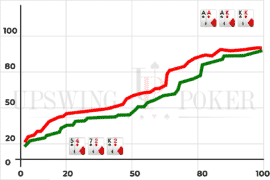
Perhaps the most important thing to consider in bomb pots is how minimum defense frequency (MDF) changes with so many players seeing the flop.
In heads-up play, MDF is a core concept. You need to defend often enough to prevent your opponent from profiting with any two cards.
But in multiway pots, that responsibility is shared across all players. This effect is amplified by the fact that so few value hands want to start building the pot on the flop.
If a bet goes in and there are five players remaining, no single player is responsible for defending the entire range. Each player can fold more often because the burden of defense is distributed.
This has a massive implication:
Players are supposed to fold more than they think in multiway pots.

Check out the above image to see just how drastically MDF changes when players are added to the equation.
In practice, most players still don’t adjust properly. Some overfold too much, others call far too wide, but very few understand how dramatically MDF shifts when multiple players are involved.
This is a big reason why your bet sizing choices end up being constrained, and small bets usually win the day.
Why Small Bet Sizes Dominate
In a typical heads-up pot, you can use larger bets to apply pressure, push your equity, and force folds.
In a bomb pot, that doesn’t work.
Because there are so many players in the hand, someone is much more likely to have a piece of the board. That makes it harder to generate fold equity, especially with large bets.
In addition, your good, but not great, hands often don’t have the kind of equity lockdown they would have in a heads-up situation.
At the same time, because MDF is shared across the whole table, no single player needs to defend aggressively. This further reduces the effectiveness of big sizings.
The result is a clear strategic adjustment:
Small bet sizes become the default.
On the flop, especially in 6- to 8-way pots, most betting should be done using small sizes, often around 25% to 33% of the pot.
These bets accomplish a few important things:
- They allow you to realize equity without bloating the pot
- They apply light pressure across multiple ranges
- They keep your range wide and flexible
Trying to force action with large bets tends to backfire when you’re multiway with many opponents. You end up building big pots in situations where your edge is small, and your opponents’ ranges are still strong.

Range Advantage Does Not Exist
Another major shift in bomb pots is the removal of range advantage.
In normal poker, ranges are shaped by preflop action. The preflop raiser generally has a stronger, more defined range, while the caller has a weaker, more capped range. This creates clear advantages that guide betting strategy.
In bomb pots, there is no preflop action, so everyone starts with a 100% range.
That means:
- No one has a meaningful range advantage
- Strategy is driven by position, stack depth, and board texture
This makes the game feel more chaotic, but it’s actually just an artifact of a completely different game entirely.
Instead of relying on preflop structure, you need to evaluate each situation from the ground up, focusing on how the board interacts with a wide range of possible hands and how your position affects your ability to realize equity.
Why You Can’t Build Big Pots Early
One of the biggest mistakes players make in bomb pots is trying to force the action too early, especially with thinner value hands or no-hope bluffs.
In heads-up pots, you can often structure the hand across multiple streets, building the pot with strong hands and applying pressure with bluffs.
In multiway bomb pots, with few hands that actually benefit from betting, that becomes less necessary. As a result, it’s very difficult to create a clean “two-street game” where you bet big on the flop and turn to set up a river decision.
Instead, the game tends to stay wide and relatively passive early on, with more action and clarity emerging on later streets as ranges become more defined.
The Big Picture
If there’s one takeaway from all of this, it’s this:
Bomb pots are not just bigger versions of normal poker hands. They are structurally different games.
- You bet less, especially out of position
- You use smaller sizes
- You rely less on range advantage
- You accept that pots will often stay multiway for longer (no thinning the field)
Most players don’t adjust enough to these realities, and that’s where the edge comes from.
In the next article, we’ll take this a step further and break down how hand strength actually works in double board bomb pots, including why one pair is often worthless and why the value of the nuts changes depending on the board.
Because once you understand what hands actually matter, everything else starts to fall into place.
Read this to find out more about how advanced strategies can boost your winrate: The River Block Bet: Why Small Bets Can Be Your Biggest Edge.