Inside a $30K CGWC Pot: TaxHere vs Jasamgale Hand Analysis
The 2025 Cash Game World Championship (CGWC) has provided us with many jaw-dropping hands, with players taking lines with hands that you just never see in everyday games.
The hand we’ll talk about today is no different. Our featured players are TaxHere and Jasamgale, two of the very best in the world for many years.
The game is No Limit Hold’Em, the blinds are $50/$100, the effective stack is $15,000, and one of them will be winning it all!
Without any further ado, let’s jump right into it!
Preflop Action
TaxHere opens up the action with a raise of $220 from the Cutoff with Ad Ks. Jasamgale 3-bets to $1,100 from the Small Blind with Kc 9c. TaxHere calls.
Simple Analysis
TaxHere has an easy preflop open-raise with a top-tier hand such as Ad Ks, while Jasamgale takes a marginal 3-bet spot with his Kc 9c.
Against this 3-bet, TaxHere can either call or 4-bet, as both of them provide distinct benefits. While 4-betting would be a higher frequency play when 100bb deep, the hand becomes weaker when 150bb are in play, which is why we see this split.
Preflop Analysis
TaxHere should be opening with around the top 30% of hands in this spot. With only three players to get through (the Button, Small Blind, and Big Blind), stealing the pot becomes a more frequent occurrence, so opening with more speculative hands becomes profitable. This effect is even more notable due to the rake-less context of the competition, meaning that there is zero cost associated with opening and seeing a flop.
This string of factors enables hands such as:
- K4s
- K2s
- Q5s
- T7s
- 75s
to become profitable open-raises in this spot.
In theory, any size between $200 and $250 is going to work well in this spot, allowing you to cheaply steal the pot while forcing a wider defense from the Big Blind with weaker, more speculative hands. This is to prevent the Big Blind from losing too much expected value (EV) by folding too frequently.
Against this open-raise, at a deeper stack depth of 150bb, Jasamgale should be defending with a pretty snug range of around 17% of hands, using a mixture of calling and 3-betting.
While at 100bb, the optimal strategy more closely resembles a 3-bet or fold scenario, the deeper stack-to-pot ratio allows hands such as high suited combos and suited connectors to call as they can end up winning huge pots some of the time for a low cost of entry.
The calling strategy is also incentivized by the CGWC’s rake-less structure, which doesn’t penalize calling more than 3-betting. If rake was a part of the structure of the game, then calling would automatically involve a punishing rake, while 3-betting wouldn’t, as you’d sometimes not see the flop and thus avoid paying rake.
The 3-betting range should revolve around the upper region of the defensive range, but should include a mix of weaker hands as well which will serve as range balancers both preflop (against 4-bets) and postflop (on different runouts).

Jasamgale needs to keep some strong hands in the calling range to avoid incentivizing the Big Blind to squeeze too often, which would result in him being denied the equity of calling too frequently.
Kc 9c should also be mixing between 3-betting and calling in this spot, but mostly leaning towards calling.
As far as bet sizing goes, anywhere from $900 to $1,100 should work well. You don’t want to risk too much with two uncapped ranges still in play (the Big Blind is still capable of having QQ+, AK).
This is where playing from the Big Blind against a Cutoff open-raise is different, as there is only one uncapped range left, thus increasing the 3-betting size is appropriate.
Against this 3-bet, TaxHere should be mixing between calling and 4-betting with his Ad Ks. While at 100bb deep this hand is much easier to get it all-in with, it becomes more marginal at 150bb deep as there is more money at risk and the opponent is less likely to shove as thinly for value as he would at a shallower stack size.
Furthermore, being in position favors letting Jasamgale see the flop, as he will have a harder time playing well.
We also have the rake-free factor, which doesn’t penalize calling.
Flop Action
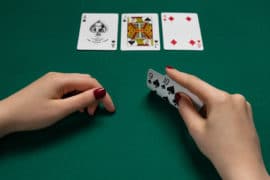
The flop comes Ts 7c 2d, and the pot is $2,300.
Jasamgale (Kc 9c) checks. TaxHere (Ad Ks) checks back.
Simple Analysis
Jasamgale should start bluffing with his Kc 9c using a big size in this spot. He would be able to filter out a bunch of stronger hands already using a 75% pot sized bet. Think Ax and low pocket pairs.
When faced with a check, TaxHere’s Ad Ks has better scenarios developing for it in the check-back line, mainly through setting up reverse implied odds to dominated Ax and Kx hands.
Flop Analysis
Jasamgale will have a nice range advantage on this flop thanks to his Broadway-heavy preflop range and due to having all the overpairs, while TaxHere’s range has far fewer of the overpairs.
For this reason, and the fact that TaxHere has a great deal of decently good hands (such as two overs with a backdoor flush draw and backdoor straight draw), it is best for Jasamgale to start blasting big c-bets at a very high frequency for thick value and equity denial.
Kc 9c is a great hand to start c-betting large with here, as it can fold out a ton of better hands (such as Ax, a few better Kx suited like Kh Jh and Kh Qh, as well as hands like 22-66), while opening the door for clearing his outs on the turn by making TaxHere fold his AK, KQs, and KJs.
Checking is thus slightly sub-optimal in my eyes, as you are creating a situation where you are going to have a hard time representing anything, and thus bluffing will become risky.
TaxHere’s check is great in this spot. It allows Jasamgale to enter reverse implied odds situations with hands such as weaker Ax and Kx, hands that would otherwise fold against a stab (think A5s, A4s, AQo, KQo, etc.).
Moreover, when the turn is an Ace or the King, Jasamgale will be more likely to bluff on those cards as they are perceived to hit his range.
Turn Action
The turn comes the 9d, making the board Ts 7c 2d 9d. The pot remains $2,300.
Jasamgale (Kc 9c) checks. TaxHere (Ad Ks) checks back again.
Simple Analysis
Jasamgale now has a clear medium strength hand that should attempt to pot control.
TaxHere also doesn’t have an incentive to bluff with his Ad Ks as he’d almost exclusively end up folding worse hands (even dominated ones such as AQ, AJs, A5s) and getting called by better.
That is the opposite of what you want to happen when you bluff.
Checking back also allows for reverse implied odds scenarios to occur for Jasamgale.
Turn Analysis
The 9d turn improves both players in similar ways. They both improve to a bunch of draws like gutshots with two overcards or open-enders, with only 99 and T9s improving to nutted hands.
The problem is that those hands that improve in any capacity in this spot are very likely to have been bet with already on the flop.
This means that, overall, Jasamgale’s range is quite weak.
His range is likely revolving around hands such as 88, AK, AQ, A7s, A5s.
If we analyze Ad Ks from a first-principles perspective with regards to its bluffing attributes, we have a hand that has an extremely low bluff efficiency.
This means that betting folds out almost exclusively worse hands, and to make matters worse, it folds out dominated hands such as AQ, A5s, A4s, or potentially a passively played KQ.
Given the most likely range distribution of Jasamgale, it makes sense to continue checking back with Ad Ks in TaxHere’s shoes. The last thing you want happening is that you bet, and your opponent folds AQ or A5s, only for the river to have come an Ace and missing out on the opportunity to catch a bluff, raise for value against a small bet, or simply value betting yourself.
The difference between the two options (bluffing vs checking) is quite large in this instance, regardless of what a solver might consider.
River Action
This is where things get spicy real quick!
The river comes the As, making the final board Ts 7c 2d 9d As. The pot is $2,300.
Jasamgale (Kc 9c) checks, TaxHere bets $1,720. Jasamgale shoves all-in for a total of $13,900, and TaxHere calls, taking home the $30,100 pot.
River Analysis
As uncommon as it may be, the As river is an action card. This is all due to the range configurations that both players will arrive with in this spot.
Jasamgale will now have a bunch of (weaker) top pairs through hands such as A5s and A4s, which will want to block-bet alongside some slow-played Tx and sets, trying to force TaxHere to bluff-catch with hands such as 88, 87s, 76s, 66-33 while losing less against his stronger Ax.
With Kc 9c, however, he should always check in this spot, as he will get called by too many better hands. Betting here would be a clear polarization error.
Against the check, TaxHere has an easy value bet. Given the strength of his holding, his 75% pot size bet is optimal. With hands such as AQ, AJs, or A5s, he should use 50% pot. This is a mathematically-incentivized way for extracting maximum value and is very hard to exploit in any meaningful way.
Jasamgale now takes a line that the solver absolutely loves and that I have never seen before. Finding the check-shove with Kc 9c in this spot is a testament to his very deep understanding of the mechanics of poker.
The secret lies in the blocker effects of this hand. This hand has a couple of great things going for it:
- It blocks TaxHere’s value range, particularly his Ac 9c, Tc 9c, and 9c 9x combos.
- It unblocks his bluffing range (65s, 54s, 55, 44).
As it usually goes with blockers, you also have some negative effects which in this case manifest through blocking TaxHere’s bet/folding range through blocking Ax Kc and Kc Qc, and Kc Jc.
The fact remains that the positive effects greatly outweigh the negative ones.
This hand is the absolute pinnacle of bluff candidates in this spot.
Having said that, if your opponent is unwilling to fold Ad Ks… then this play is actually not going to be profitable.
The investment rests its benefits on the opponent’s ability and willingness to fold his AK against the humongous shove.
Now, to be clear here, this doesn’t mean that TaxHere made a mistake necessarily. Let me explain why.
If he perceives that Jasamgale will have taken a different line with TT and/or 99, and that this line is actually devoid of such nutted hands, then calling here is absolutely the best play.
In solver-land, however, this hand is a very slightly -EV call.
Final Thoughts
I chose this hand because it exemplifies what it takes to be the best: deep knowledge, massive courage, and high confidence in yourself. You have to not only know what things to look out for, such as the mechanics of the game and the psychology of the opponent, but also to have the courage to risk a lot of money on it, which necessarily implies having a high degree of confidence in yourself.
The best in the world know the game, make hypotheses, test them in real time, gather the feedback from the real world, and make adjustments. Over and over and over again. This is an infinite game we’re playing.
That wraps things up for this piece. I hope it clarified a few things and gave you something useful to take away. If you have questions, corrections, or thoughts of your own, the comments are open.
Till next time, good luck, grinders!
To learn more about how precise river play can make you more money, read: The River Block Bet: Why Small Bets Can Be Your Biggest Edge.