

Poker Strategy Articles
The best source for free poker strategy articles. Browse our collection of 100s of articles on cash games, tournaments, online poker, live poker, and key concepts ranging from beginner to advanced. Stay ahead of the game with new articles delivered weekly.
check the boxes to filter by category









Want to Test Your Poker Skills?
Fundamental Poker Strategy
Since you clearly want to learn more about poker strategy, check out the sections below to improve your understanding of the fundamentals.
Get the Preflop Guide with 8 Easy-to-Read Charts
Download and use these charts so you know exactly which hands to raise before the flop. You can even use them while you play (until you memorize them).
What You Should Know Before Playing
Poker is a game of the skill, but there is an element of luck that makes it impossible to win every time. Even the world’s best players with the most cutting-edge poker strategies go through losing stretches, but over the long term they consistently turn a profit.
These players have gotten to where they are through years of hard work, spending countless hours playing the game, and studying poker strategy away from the table. If you want to be a winning player, the road to that goal is not easy.
The good news is that hard work pays off in poker. Your long-term results will directly reflect the amount of work you put into your game.
Poker is entertaining and fun to play, but even if you want to just play for fun, it’s good to know the fundamental concepts and math of the game. After all, winning is fun. If you want to win, it’s absolutely crucial to become intimately familiar with these concepts.
Whether you’re playing for fun at the smallest of stakes or dreaming of competing in the World Series of Poker, here are some things you should know about the game (we'll get to specific poker strategies shortly).
Practice and Study Makes Perfect
The amount of time and effort you put into studying poker will have a tremendous impact on your long-term results. Poker is a complex game with an effectively infinite amount of possible situations you might face. The edge you have over your opponents comes from the knowledge of how to play optimally in as many situations as possible.
Studying poker strategy alone, however, isn’t enough. You have to play a lot as well as there is no substitute for experience in poker. Playing allows you to put your accumulated knowledge to the test so you can see how the strategies you've studied work in a real-life game with money on the line.
Putting in the hours, both on and off the table, are how you will get positive results.
Prepare for Variance
Again, poker is a game of skill, and strong players with the best poker strategy will almost always win over a long period. In the short term, however, even the world’s best players experience losing streaks.
It’s impossible to win every single hand or session that you play. If you’re going to play poker, you have to be willing to accept that sometimes it just won't be your day. A major part of a successful long term poker strategy is the ability to handle short term downswings.
Losing in the short term doesn’t necessarily mean that you’re a bad player or that you played bad. Even if you were dealt pocket aces every hand, you would still lose some hands due to the concept of variance.
Variance is the difference between the mathematically expected result and the actual result. For example, in Texas Hold’em, AA is an 80 percent favorite against KK, QQ or any other smaller pocket pair before the flop. If you deal AA against KK ten times, AA “should” win eight out of the ten times. Occasionally, however, AA will only win five times out of ten, or it will win all ten times.
Variance is unavoidable in poker. As a result, the ability to mentally and emotionally deal with the natural upswings and downswings of the game will be essential to your long term success.
Avoid Frustration (a.k.a. Tilt)
Tilt, which is what poker players call game-related frustration, affects even the most veteran pros. Tilt goes hand-in-hand with variance, as you’ll sometimes experience losing hands and sessions even when you’re playing your A-game.
Understanding and managing tilt is crucial to success in poker. When you find yourself losing in situations that your opponent played illogically or recklessly, you have to keep your cool. That can be a lot easier said then done, especially as you watch your opponent rake in a large pot of chips that you feel should be yours.
These situations are inevitable in poker. How you react to them will have a huge impact on your bottom line. If the results of a single unlucky hand impact you to the point that you start playing poorly, that one lost hand can turn into an entire session of disaster.
Many things can happen at the poker table that may cause you to feel tilted. It could be a trash-talking opponent, a recklessly aggressive player getting lucky, or a long stretch of unplayable starting hands.
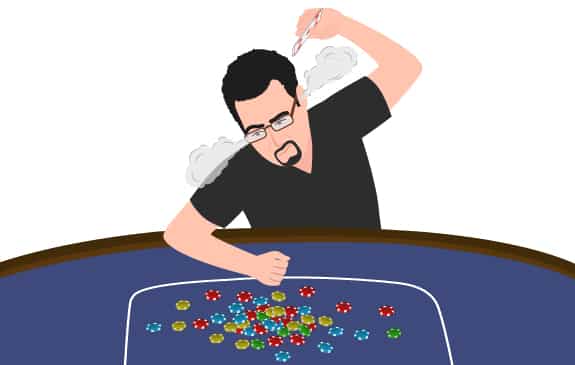
Understanding what makes you go on tilt, and learning how to manage your emotions and not let frustration lead to bad decisions, will go a long way toward your success in poker.
From beginner to advanced poker strategy articles, and even videos, we have you covered.