5 Situations Where C-Betting Is a Big Mistake in Poker Tournaments
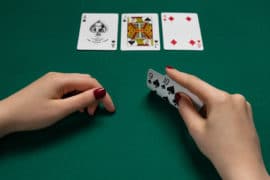
C-betting is super effective in MTTs, so it’s no surprise that it happens so frequently. On average, after you open-raise, you’ll c-bet 60-70% of the time.
But that also means there are times you don’t.
In this article, you’re going to learn five specific situations where c-betting is a huge mistake. In fact, if you’re c-betting in these spots, you’re practically flushing chips down the toilet.

Situation #1 – When You’re Under Serious ICM Pressure
If you’re facing a bigger stack who can apply pressure, you’ve gotta play more defensively. You can’t just attack.
For example, suppose you’re on the money bubble, weighing whether or not to c-bet as a middling stack (25bb) vs a huge stack (65bb). Or let’s say you’re at a final table with seven players left where you’re second in chips with 50bb.
You raise preflop. The chip leader, sitting on 80bb, calls from the Small Blind. In both situations, your opponent can leverage ICM against you. And they should.
In ICM, when you are the player at risk of busting, you need to play more defensively.
With hands you’d normally bet, you might be better off checking. Especially if you have a marginal hand or draw. Imagine holding Jh Th on a 9d 7d 4c flop.
While it’s tempting to c-bet with your gutshot and two overs, getting raised would be brutal. You’ll have to decide between calling and risking more chips in a bloated pot. Even when you turn a pair, you’re still in no man’s land. Or you can fold, which you really don’t want to do either.
By checking, you can avoid that situation altogether.
Don’t be so eager to play pots when a big stack can leverage ICM against you.
By the way, I used the Lucid Poker Trainer to find most of these spots, and I’m using it for this article. If you like winning at poker, you should know that Lucid Poker is now free to play. It’s a fast, fun, and effective way to improve your skills.
Go to LUCIDPOKER.COM to get started for free. We highly recommend making the Daily Cardle quiz a regular part of your study routine.
Situation #2 – When You’re Out of Position (OOP) in a Wide Range Battle
Let’s suppose you’re playing 25bb effective stacks. You open in the Cutoff and the Button calls. A Qh Jd 5c flop is dealt.
Believe it or not, you should be checking a lot.
Take a look.

Lucid Poker actions breakdown for OOP: Cutoff vs Button, 25bb effective on QJ5r.
You should check a lot. About two-thirds of the time.
In this spot, your range has a significant representation of medium-strength hands, marginal draws, and complete misses. Do you check these, betting only your strongest combos?
Of course not.
See below.

Lucid Poker OOP strategy for Cutoff vs Button, 25bb effective on QJ5r. Cutoff has a lot of unpaired Ax, Kx, suited connectors and gappers, underpairs to second and third pair, second pairs, and top pairs with weak kickers (Q6s).
You check your strong hands too. A benefit of checking your strong hands is that you protect the equity of the middle and bottom of your range.
But is this always the case?
Let’s see.
|
Lucid Poker actions breakdown for OOP: Under the Gun vs Button, 25bb effective on QJ5r. UTG c-bets 82% (combined) and checks 18%. |
Lucid Poker actions breakdown for OOP: Lo-Jack vs Button, 25bb effective on QJ5r. Lo-Jack c-bets 54% (combined) and checks 46%. |
|---|


Notice that you c-bet more often when the opening range is earlier, and therefore tighter. Early position opening ranges index on top-end strength (big cards, big pairs).
Thus, Under the Gun and Lo-Jack bet a lot, having a lot of natural strong value.
This is a widespread trend in GTO strategies.
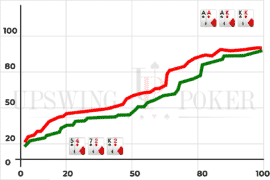
Check any flop in the Lucid GTO trainer (medium flops, high flops, paired flops) and you’ll find a high checking frequency when playing from the Cutoff against the Button.

Slide from “Do NOT C-bet in Poker Tournaments”. Comparing Under the Gun and Cutoff’s checking frequencies vs the Button on different flop textures.
Spot #3 – Multiway Pots
When you’ve got multiple ranges to worry about, it’s usually right to start with a check.
This is true on almost all flops, but especially those which are neutral or unfavorable for your range.
When you’re heads-up, the equity is split between you and one other. It’s reasonable to bet a lot. But when you have a third, fourth, or fifth player in the hand, you don’t have the same amount of equity. So you check.
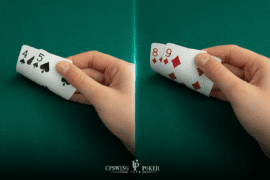
For example, let’s say you open Ac 4c and an As Kh 9d flop is dealt.

Cardplayer Equity Calculator Tool: A4s vs QTs on AK9r. A4s has 77.88% equity and QTs has 22.12% equity.
When your opponent has Qd Td you have about ~78% equity. Betting makes sense.
But what happens if we add a third player?

Cardplayer Equity Calculator Tool: A4s vs QTs and K8s on AK9r. A4s has 57.25% equity, QTs has 22.15% equity, K8s has 20.60% equity.
Now, A4s, the best hand on the flop, sees a ~20% drop in equity which the third player takes.
Ok, let’s add a fourth player.

Cardplayer Equity Calculator Tool: A4s vs QTs, K8s, and 33 on AK9r. A4s has 49.39% equity, QTs has 23.17% equity, K8s has 20.37% equity, and 33 has 7.07% equity.
Now, A4s equity drops further. And remember, we are pretending we know our opponent’s exact hands which we don’t. As your equity decreases, you should bet less often. Multiway pots mean less c-betting, ipso facto.
There is an exception though.
When you’re up against exactly two opponents and they’re both in the blinds, you get to c-bet more.
There are at least three reasons for this.
- Ranges are wider, which works out to more auto-folds.
- Because neither player 3-bet, they are more capped than a Button flatting range (which includes strong pocket pairs, Ace-Queen and even Ace-King).
- Small Blind has to fold greater than minimum defense frequency (MDF) since they have to play OOP vs two players.
So if you’re going to c-bet in multiway pots, do it when your opponents are in the blinds.
Spot #4 – Low connected flops IP vs the Big Blind
A helpful way to think about c-betting is by categorizing flops as they relate to your range.
Good flops, ok flops, and bad flops.
- Naturally, on good flops – c-bet more.
- On ok flops – c-bet sometimes.
- On bad flops – c-bet less.
- Sometimes a lot less.
Let’s say you open the Hi-Jack, Big Blind defends, and you see a 7d 6d 5c flop.
This flop is so good for the Big Blind that the solver elects to lead nearly half of the time.

Lucid Poker actions breakdown for OOP: Big Blind vs Hi-Jack, 25bb effective on 7d 6d 5c. Big Blind leads 42% and checks 58% frequency.
When the Big Blind checks, you bet about half the time. But are your opponents playing this spot like a solver? Are they leading out over half the time when they flop the nuts?
Are they firing a bet with all of these top pairs and decent draws like the solver would? I’m going to go out on a limb and say the answer is no. On these textures, your opponents will be carrying a lot more strength in their checking range than GTO supposes.
This means you should check after they do.
Solver strategies shouldn’t be treated as a master, but a servant.
Spot #5 – When You’d Hate Your Life If They Shoved All-In
Remember the earlier Jh Th hand? In that instance, ICM meant your opponent could press you to make big folds, making you want to check more often.
However, that tactic is not exclusive to ICM. It happens whenever, by betting, you jeopardize your equity realization while also improving your opponents’ equity realization. You’ll see this a lot at shallower stack depths where betting triggers an aggressive response from your opponent, usually the Big Blind and when there isn’t a lot of folding.
There, checking helps preserve your equity.
Let’s say you’re dealt Kc 7c in the Hi-Jack. Big Blind defends. A 8d 6d 2c flop is dealt.
They check. What’s your play?
Let’s ask Lucid.

Lucid GTO Hi-Jack strategy for K7s combos on 8d 6d 2c. The highest frequency check is the club variant.
It’s natural to want to bluff a hand like K7s. You have a good overcard and a backdoor straight draw. Half the time you have a flush draw to go with them.
But Kc 7c is special.
Kc 7c doesn’t want to get check-raised and blown off their equity. And on this board, you’re going to see a lot of check-raising. That’s on top of how frequently your opponent will be calling your bet.

Lucid GTO actions breakdown for OOP: Big Blind vs Hi-Jack, 25bb effective on 8d 6d 2c. Big Blind check-raises 24% frequency combined, calls 48%, and folds 29%.
What happens when they check-raise to their dominant size (50% pot)?
Take a look.

Lucid GTO Hi-Jack strategy for K7s combos on 8d 6d 2c facing Big Blind’s 50% pot check-raise. Only the front door flush draw combo continues.
Womp womp womp.
Remember, this is facing a non-all in check-raise. If your opponent starts check-raising all-in, that’s extremely bad for your middle of range c-bets.
How about this instead:
Check.
For more on this, you should watch: DO NOT C-BET in Poker Tournaments.
For more on c-betting, see: How to Build Strong Flop Check-Back Strategies in Tournaments.
And if you haven’t yet, check out Lucid GTO here.
Good luck!