Mystery Bounty Strategy: How to Attack Once the Bubble Bursts
A sigh of relief.
A thrill of hope.
Could this be the day?
That’s how surviving a money bubble can feel.
But the feeling is even more pronounced in Mystery Bounty knockout (MB or MBKO) tournaments.
Because making ITM in a Mystery Bounty means a lot more than the min-cash you’re guaranteed.
Eliminating just one player can mean winning the world.
And while you can’t control your luck, there are controllables.
This is part two of a two-part series on Mystery Bounties. Check the first one out here.
In this article, you’re going to learn how to play the bounty phase of mystery bounties like an absolute genius.
In this article, you will learn:
- Why the bounty phase in Mystery Bounties plays differently than a normal ITM stage.
- How to calculate the average bounty value and convert it into chips.
- Why ranges become extremely wide immediately after the bubble bursts.
- How covering other players changes your incentive to VPIP, call, and chase bounties.
- Why covered stacks also get to play wider for value.
- How bounty incentives shrink as the tournament progresses and ICM becomes more important.
The Bounty Phase…s
In Mystery Bounties, reaching ITM means the bounties finally become accessible to the remaining players.
But the bounty phase (ITM) isn’t just one phase. It’s really several.
Once the bubble bursts, players are vying for two separate prize pools. Each with their own priority.

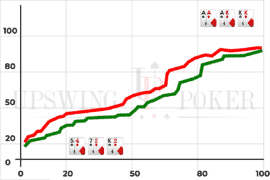
In MBs and other KO formats, your tournament equity isn’t just a matter of final placement payouts (i.e. survival, ICM, vanilla strategies) but your ability to secure your fair share of the bounty prize pool. This generates tension in your strategy (depicted above). The type of KO you’re playing largely determines when you prioritize either end of the continuum.
Except in extreme examples (more later), the above graph maps out how MB ranges typically behave once the money bubble bursts continuing through to the end of the tournament.
Lots of gambling right away then a gradual descent into more typical ICM style play as the average bounty value decreases and the payjumps become more meaningful.
This means mistakes are amplified or smoothed out by the stage of the tournament.
Often, players gamble too much or too little.
- Gambling too loose means you aren’t compensated for the risk which only serves to redistribute your tournament equity to the other remaining players.
- Gambling too tight means you leave money on the table.
Both mistakes stem from the same knowledge gap.
Bounty Mathematics
Heads up: If math calculations bore you, skip to the next section.
In a traditional tournament, when facing an all-in, calculating the required equity to call an all-in is simple.
Formula for Required Equity
Required Equity = Risk / (Risk + Reward)
Where:
Risk = the amount you must call
Reward = the amount you can win, excluding the chips you call
Example
You must call 1,000 to win 1,500.
Required Equity = 1,000 / (1,000 + 1,500)
Required Equity = 1,000 / 2,500
Required Equity = 40%
That means your hand needs at least 40% equity versus your opponents’ range to break even in chip EV.
In late game scenarios, there is a tax for risking chips since the majority of the prize pool is concentrated at the final tables, making a single chip worth significantly more money than when you registered. This results in much higher equity thresholds to engage and risk elimination i.e. high risk premiums.
However, in KO formats like MBs, the threshold for taking risks sharply decreases, a feature of the added EV that bounties present i.e. negative risk premiums.
Where ICM taxes risk, bounties incentivize it.

How to Calculate Mystery Bounty Value
Unlike PKOs where the bounty dollar value is visible to every player, the mystery element of MBs means you can’t know what’s up for grabs.
For this reason, you want to calculate the average bounty.
You aren’t concerned with the top or bottom of the prize curve but on average, what you win after eliminating a player.
To do that, you need to know the following:
- Remaining Players
- Total Bounty Prize Pool
How to Calculate Average Bounty:
At the beginning of the ITM or bounty phase, divide the total bounty pool by remaining players.
Average Bounty = Total Bounty Prize Pool / Remaining Players
Example — $200 event with 1000 runners. 50K starting stacks. 50% to the main prize pool and 50% to the bounty prize pool i.e $100,000 to each. 12.5% paid (ITM) or 125 players.
Average Bounty = $100,000 / 125
= $800
This is the important number. Even though 10% of the total prize money might be stored in a single bounty, this is irrelevant to your math.
On average – in this instance –, each bounty is worth 8x the main prize pool contribution ($100 of the $200 entry goes to the main prize pool).
However, you need to go one step further to make this strategically relevant. This value needs to be converted to a chip value.
How to convert $ Bounty Value to Chips
Let’s use the same example as earlier, you paid $200 to enter the tournament. $100 went to the main prize pool for which you received 50,000 tournament chips.
In other words, 50k chips (1 starting stack) = $100.
Since we know the average bounty is $800, calculating its chip equivalent is easy.
Average bounty in starting stacks = Average bounty / Main Prize Pool Contribution
In our example,
Average bounty in starting stacks = 800 / 100
Average bounty in starting stacks = 8
Since we started with 50k starting stacks, an average bounty in chips is:
50,000 x 8 = 400,000 chips
This number, in chips or converted to BBs, needs to be factored into your required equity calculation.
Example:
Let’s say the blinds are 10k/20k with 20k in antes and your opponent moves all in for 500,000.
In a standard cEV spot, you would use the basic required equity formula.
Required Equity = Risk / (Risk + Reward)
= 500,000 / (500,000 + 500,000 + 10,000 + 20,000 + 20,000)
Required Equity = 47.6%
However, in a bounty, you need to add the bounty equivalent in chips (or bbs) to your calculation as part of the reward.
= 500,000 / (500,000 + 500,000 + 10,000 + 20,000 + 20,000 + 400,000)
Required Equity = 34.5%
Compared to the vanilla spot, you need ~13% less equity to breakeven. That kind of equity discount springs many losing hands to winning ones.
Note: This calculation does not factor the relationship between your stack value, number of chips relative to the total chips in play, or future game. It is a crude approximation which will get you closer to the “right” answer.
In tournaments, risk premiums (the ICM tax) are always positive, requiring higher equities than in cEV. The required equity in KO formats stands in complete contrast.
And it’s this math that undergirds the wild play you see during the bounty phase.
KOs provide a counter-incentive which draws the risk premiums back, called a bounty discount.
For the purpose of this article, the math and strategy section will be most valuable at the beginning of ITM until ICM starts to get hot.
How to Play The Bounty Phase in Mystery Bounty Tournaments
At the beginning of the ITM stage, the bounty equity discount will be highest.
The bounty prize-pool is shrinking from hand one of ITM. This means the average bounty is at its peak and will only decrease as each elimination is dealt.
Remember, half of the prize pool is locked up in the lottery. With no significant ICM pressure, playing for the bounties becomes your main priority.
For these reasons, a roller-coaster of gambling begins once the bubble bursts.
Example – Hand One ITM with Under the Gun Chip Leader
To illustrate, let’s use the earlier tournament example.

Holdem Resources Calculator (HRC) — Table View. $200 mystery bounty tournament ($100 + $100). Average bounty worth $800 at the beginning of ITM. The Under the Gun chip leader with 50bbs covers everyone at the table.
In this scenario, UTG covers everyone at their table. How should they play?

HRC – UTG strategy as table CL first hand after money bubble bursts in $200 mystery bounty tournament. UTG min-raises 100% of hands dealt.
With the bounty incentive at its peak, UTG is supposed to open a 100% range. ~80% wider than cEV.
Every hand is profitable.

Bad hands make money. Even a hand like seven-deuce offsuit, considered the nut low by many, makes $42.5 in dollar EV.
At first, this may seem crazy.
But consider that you aren’t playing for any meaningful payjumps. Winning extra chips or losing them doesn’t really matter at this stage.
What matters is putting yourself in a position to capture bounties and VPIPing unlocks the bounty possibility.
You can extrapolate this to also mean that limping is very profitable.
Example — 40% of Bounty Prize Pool removed, 23 ITM players eliminated.
In this instance, a mix of bounties have been drawn which includes the largest bounty and a mix of others. 102 players remain and the average bounty is now $588.

HRC – UTG strategy as table CL in $200 mystery bounty tournament where 60% of bounty prize pool remains. 102 players remain from 125 ITM. UTG min-raises a 93.7% range.
Notice a couple things.
- The decreased average bounty means a drop in RFI ranges. UTG opens ~6% tighter. As bounties exit the prize pool and the average bounty decreases, ranges contract.
- Despite losing the largest bounty from the pool, the average bounty still incentivizes wide RFI ranges. It is not about the biggest bounty.
After UTG opens in hand one of ITM, look at how the table responds.

HRC – Player responses after UTG raises. EP flat-calls a ~79% range. MP can flat-call a 40.5% range. HJ flat-calls a 48.3% range. BTN flat-calls a 47.5% range. SB flat-calls a 60.3% range.
- If you cover someone behind you, you get to call very wide.
- If you cover someone behind you, you don’t want to 3-bet – even your strong hands.
Let’s say UTG opens and EP flat-calls. This is the most frequent node in this scenario. When it happens, what does everyone else do?

HRC – Player responses after UTG opens and EP flat-calls. MP can over-call a 32.7% range. HJ over-calls a 39.4% range. CO (short stack, doesn’t cover anyone) over-calls a 21.2% range. BTN over-calls a 13.7% range. SB over-calls a 62.2% range.
Facing an open and a call, ranges continue to be extremely wide.
But what if UTG or EP open-fold?

HRC – When folded to, ranges are much wider than in cEV. In this instance, MP plays a 46% range, Hi-Jack (HJ) plays a 44.9% min-raise and 7.9% all-in, BTN plays a 60% range and SB open-shoves with any two.
If folded to, no one really wants to fold. As long as there is someone behind who you can knock out, you want to play anything with a modicum of winnability.
HRC. MP RFI strategy after UTG and EP fold. MP min-raises a 46% range.
Even covered stacks, provided there is someone behind they cover, want to tango. For example, the player in Middle Position (MP) with 18bbs, covers only 1 player and opens a 46% range.
However, it’s not just the ability to stack your opponent and win a bounty that affords these wide ranges. We can better understand what’s happening by looking at how the short stacks play.
Example – Short Stack Responses
Let’s say UTG opens and it folds to the CO.
What do you do if you’re the short stack in the CO?

HRC – Hand one ITM. CO (10bb stack) facing UTG chip leader min-raise. CO reshoves a 28.3% range.
Since UTG will not fold versus your shove (They call 100% of their range), you get to reshove a very wide value range.
Hands like ace-four offsuit, queen-nine offsuit and jack-eight suited make money.
Think about it this way. If your opponent opens 100% and is intent on calling a shove with any two, then you shove 1/3 of the deck. This kind of wide value shove repeats in the open and flat-call nodes as well.
This is also why you see the wider opening ranges of stacks that are covered. Since you know your opponents are trying to chase you down for a bounty, many marginal hands become much more profitable.
Opening a 35% range is good when you know you’ll be getting called by a 50% range.
Takeaways
Once ITM is reached in MBs, you want to play an inclusive preflop strategy.
When you cover, this means laying attractive odds for your opponents to realize some of their equity. In exchange, you gain access to their bounty.
That’s the baseline wager of KOs.
When covered, you get to play wider ranges for value, and your opponents get to chase you for an incentive that you have no access to.
This plays out in a few ways:
- Wider opens.
- Wider flat-calls and over-calls.
- Limps.
- Multiway pots.
- Wider reshoves.
- Wider multiway all-ins.
As the average bounty decreases and the placement payouts become more considerable, play returns to vanilla, ICM-informed gameplay. The exception is when the larger bounties remain when the field has shrunk, making the average bounty a bigger factor.
Hopefully, you draw a big one early in your career and don’t have to sweat the math anymore.
Gambol.
Learn more about Unlocking the Mystery: Early Stage Mystery Bounty Tournament Strategy
To learn more about how to defend against your aggressive opponents, read: How to Defend Against Large Flop C-Bets in Poker Tournaments.