How to Defend Against Large Flop C-Bets in Poker Tournaments
By Leo Song-Carrillo · MTT Pro
Being on the receiving end of a large flop c-bet can feel intimidating in a poker tournament. The pot swells quickly. Bad calls are punished.
For some players, that fear produces an automatic fold.
For others, it sparks rebellion. You fight back, sometimes at the wrong time, and suddenly a manageable pot becomes a stack-threatening one.
Elite players do neither.
They understand what large bets actually do to ranges.
Postflop: Classifying Your Hands
Preflop, hands are grouped into categories: pocket pairs, suited connectors, broadways, Ax. Postflop, classification becomes more important.
Two-card hands become five-card hands. Absolute strength becomes relative strength. What matters is how your hand performs versus your opponent’s betting range.
When defending versus a large c-bet, use a consistent framework.
One practical classification:
- Nuts – Straights, flushes, sets
- Near Nuts – Strong two pair+
- Pairs – Overpairs, top pair, second pair, third pair
- Strong Draws – Nut flush draws, open-enders (especially with overs)
- Weak Draws – Gutshots, backdoor draws
- Overcards – A-highs and broadways
- Very Low Equity – Hands that cannot profitably continue
You can also group hands by expected value (EV):
- Very High EV – Worth more than the pot
- High EV – 50–100% of the pot
- Mid EV – 15–50% of the pot
- Low EV – 1–15% of the pot
The purpose of classification is efficiency.
When facing a large bet, you should immediately recognize which bucket your hand falls into and how that bucket performs versus a polarized range.
This reduces guesswork and keeps decisions consistent.

Folding, Calling and Raising
And it’s in that order.
When you face a range c-bet (25-33% pot), you mostly call, raise some and fold least.
But the price has gone up.
A large bet means a lot of your hands are “priced out” of the market.
The EV of the bottom and middle of your range goes down.
You have to fold more.
And because your opponent is putting in chips for you, the incentives for check-raising are diminished.
Their range is also more polarized, making thinner value and low-EV check-raise bluffs less profitable.
When you continue versus the bet, you should mostly call.
If you do check-raise, you further polarize the situation, requiring hands that can take the heat or that have no choice.
Example – Low-Mid EV
You are in the Big Blind and call an open-raise.
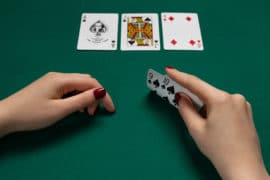
The flop is As 8h 7d.
You check and face a large 75% c-bet.
Let’s look at this spot versus early and late position c-bets.
What should you do?

Lucid Poker Action Breakdown – BB v UTG, 50bb effective. BB facing 75% pot c-bet on A87r.
- Blue: Fold.
- Green: Call.
- Red: Raise 30% pot.
- Dark Red: Raise 67% pot.

Lucid Poker Action Breakdown – BB v BTN, 50bb effective. BB facing 75% pot c-bet on A87r.
- Blue: Fold.
- Green: Call.
- Red: Raise 30% pot.
- Dark Red: Raise 67% pot.
Check out the similarities in folding frequencies against both UTG and the Button:
- Versus UTG, the solver folds 61% of the time.
- Versus Button, the solver folds 60% of the time.
The first thing to notice here is how much you should fold. Versus both positions, the folding frequency is ~60%. You don’t get to exploit the Button’s wider opening range. The size of the bet, combined with their range and nut advantage, drives your continuing frequency down, significantly lower than minimum defense frequency (MDF).
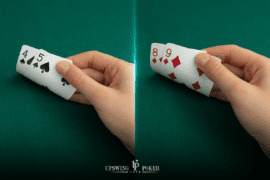
Let’s look at one combo and see how it performs in both scenarios.
|
Combo EV – 9s 8c facing 75% pot c-bet, BB v UTG, 50bb effective stacks. Combo loses 0.08bb and should always fold. |
Combo EV – 9s 8c facing 75% pot c-bet, BB v BTN, 50bb effective stacks. Combo wins 0.28bb and should always call. |
|---|


- Facing UTG, second pair with no backdoor flush draw pure folds, losing 0.08bb.
- Facing Button, second pair pure calls, making 0.28bb.
The Big Blind’s fold frequency is similar in both cases, but the behavior of individual combos changes. Second pair is worth significantly more versus the Button than versus UTG. However, even versus the Button, it’s worth only about 5% of the pot, which has implications for the EV of your third pairs.
Now let’s assume our opponents chose a smaller size instead.
|
Combo EV – 9s 8c facing 33% pot c-bet, BB v UTG, 50bb effective stacks. Combo wins 0.15bb by calling. |
Combo EV – 9s 8c facing 33% pot c-bet, BB v BTN, 50bb effective stacks. Combo wins 2.09bb by calling. |
|---|


We see that our 98o combo is a pure play in both spots.
Notably,
- Versus UTG, 9s 8c gains EV when facing 33% pot, winning 0.15bb by calling.
- Versus Button, the EV increase is even more pronounced.
These examples illustrate:
- Increased bet size drives EV down for middle- and bottom-of-range hands.
- Position amplifies this effect. The tighter (stronger) the opening range, the more severe the EV compression.
From here, we can make an assumption:
If large bets reduce the EV of your middle and bottom range hands, then the EV of your top-range hands should increase.
Let’s test that.
Example 2 – Very High EV
Same board. But this time, you’ve flopped two pair.
What are the implications for your strongest hands?
|
Combo EV – 8s 7c facing 33% pot c-bet, BB v UTG, 50bb effective stacks. Combo wins at least 7.73bb. |
Combo EV – 8s 7c facing 75% pot c-bet, BB v UTG, 50bb effective stacks. Combo wins at least 12.96bb. |
|---|


- Facing a 33% pot c-bet, your two pair wins roughly the size of the pot (around 7.73bb).
- Facing a 75% pot c-bet, your two pair wins substantially more (around 12.96bb).
Why?
When you hold a high-equity hand, meaning your pot share exceeds 50%, a larger portion of the money going into the pot belongs to you. Larger bets increase the EV of the top of your range.
This is why slowplaying is often a mistake in these spots, and why hands stronger than one pair frequently check-raise.
Large bets compress the middle and bottom of your range and expand the value of your strongest hands. That’s the tradeoff.
Bigger bets compress the EV of your middle and bottom range, forcing you to fold more. At the same time, they increase the value of your strongest hands.
Once you understand this redistribution of EV, the adjustment is straightforward:
- Fold more of your marginal hands
- Call with hands that retain sufficient equity
- Raise with hands that benefit from the increased pot size
That’s the correct response to large c-bets.
If you want to see exactly how these adjustments play out across different board textures, stack depths, and positions, Lucid Poker allows you to study optimal defenses versus every bet size on every board. You can try it for free here.
To learn more about how c-bets can impact your strategy, read: 5 Situations Where C-Betting Is a Big Mistake in Poker Tournaments.