Why Milestone Satellites Require a Different Poker Strategy
Moneymaker. The Poker Boom. Do you know what they have in common?
Moneymaker’s historic run began in an online qualifier.
However, that was in a traditional satellite.
If you’re chasing your own Moneymaker moment, you need to know how satellites work — and today, that means understanding milestone satellites.
In this article, you’ll learn:
- What milestone satellites are
- The differences between milestones and traditional satellites
- If and when you should late reg
- Major milestone satellite considerations
- How to play when you’re near the target stack
What is a Milestone Satellite?
Milestone satellites are a variant of satellite poker tournaments in which you have two, not one, ways of winning the ticket. In a milestone, accumulating a preset number of chips buys a seat into the target event.
Typically, a satellite tournament distributes an equal-value prize to all ITM players — usually 5-10% of the field. Sometimes it is paid in cash, like survivor events, but normally, these award an entry to a target event.
In milestones, that doesn’t change. It’s the introduction of the second “track” to win that changes the game — a lot.

Why The Distinction Matters
In a normal satellite, you are just trying to survive. Chip accumulation really serves that end.
Making ITM with one chip pays the same reward as being the chip leader.
In the sense of the ultimate reward, nothing changes.
It’s the introduction of the target stack payout that makes the difference.
Once the target stack is reached, the player’s chips are removed from the game, and so is one of the prizes.
- Like a bounty tournament, where the bounty prize pool shrinks from the outset, the fact that a prize can be removed from play before ITM in a milestone generates strategic urgency.
- Unlike a bounty tournament (where the bounty prize pool is separate from the main prize pool), in a milestone satellite, you are still vying for just one prize pool. This makes it more urgent.
- In a mystery bounty, there is an incentive to run up a stack before ITM. This means you can capture more of the bounty prize pool than your tablemates. While being shorter at ITM doesn’t totally deny your ability to capture bounties, it does limit which bounties you can capture and how much variance you can handle. Milestone satellites share common, conceptual ground.
By running up a stack, you give yourself a better chance of reaching the target stack sooner, allowing you to capture the ticket/equity before others do.
This means a strong cEV game matters more than it does in a traditional satellite, especially when you have a long way to go. But this is not a full return to normal tournament poker, because the value of accumulating chips caps at the milestone. Once you get close, the goal shifts from building to protecting.
Major Considerations in Milestone Satellites
Average Chips at ITM versus Target Stack
Let’s assume you start with 10,000 tournament chips.
In a 1-in-10 satellite, each ticket corresponds to roughly 10 starting stacks. If all seats were awarded in a traditional satellite, the average qualifying stack would be 100K chips.
Note: In real life, the chip distribution at ITM varies. A spread from micro stacks to big stacks will exist throughout the tables, which skews ICM values before the bubble bursts. One chip on the bubble is worth a lot!
However, milestones tend to price the target stack differently. For example, in the same tournament, they might assign 120K chips as the qualifying stack. This serves as a dollar premium to the player trying to make an early exit.
In other words, if the tournament pays 1 in 10 players but the milestone is set at 12 starting stacks, qualifying through the milestone requires you to accumulate 12 buy-ins worth of chips to win a 10-buy-in prize. That extra 20% is the premium you pay for locking up the seat early.
At some point, the qualifying multiple of the starting stack can make reaching the target stack too much of an uphill battle.
It would be silly to try to reach the target stack for a 1-in-10 if you need 20 stacks to qualify.
The closer the Target Stack is to the ITM average stack, the more you can approach the earlier stages aggressively. How long you should play this way is going to be determined by a few other considerations.
Remaining Seats and Chips in Play
In a standard 1-in-10 satellite, there is one prize for every 10 registered players. With 100 runners, there will be 10 tickets paid.
In this case, the ratio of players to prizes will be 10-to-1. Players get a prize for every 10 starting stacks achieved, so 10% of the field is paid.
This matters more in milestones because the number of available seats can change before the tournament reaches the bubble.
At the start of a milestone, the ratio is identical in both formats. However, since prizes are removed as target stacks are reached, it is more dynamic in the milestone.
In a traditional satellite, the prize number remains the same, and only the remaining number of players decreases. This has implications for the ICM values of each remaining stack.
- For example, in the 100-runner $100 vanilla satellite, once half the field has been eliminated, a starting stack’s ICM value means you can auto-profit by entering (in theory).
The equity from 10 tickets, once shared by 100 players, is now shared between 50 players.
And, since there are no ladders, just equal ITM payouts, coming in short is further ICM-rewarded.
If you didn’t know already, max late regging vanilla satellites is very profitable.
However, in a milestone, the remaining prizes are also in flux as target stacks are reached and prizes removed. This means the relationship between players remaining and prizes remaining is a lot less predictable.

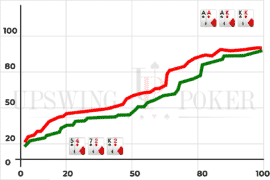
Figure: In traditional satellites, bustouts reduce the field while the number of prizes stays fixed. In milestone satellites, players can qualify early, removing available seats before the bubble.
Example:
Take the same situation, but remove four prizes from the game.
Instead of 50 players to 10 prizes or 5-to-1, it’s now 50 players to 6 prizes. The payout rate drops from 20% of the remaining field to 12%. In other words, your distance from the prizes (measured by eliminations needed) has increased.
But there’s another layer here: the target stack does not adjust downward. If the qualifying stack is 120K, it stays 120K no matter how many chips have already been removed from play.
So, when players reach the milestone, they don’t just remove prizes. They also remove chips. The remaining players are now competing for fewer seats with fewer chips in circulation, while still chasing the same fixed target stack.

This is especially important when a player qualifies with more than the target amount. Let’s say an 80K stack doubles through another 80K stack, and the winning player may qualify with 160K. That removes one ticket from the tournament, but it also removes 160K chips from play. Depending on the site’s rules, those extra chips may be removed from play rather than redistributed. If they are removed, the milestone becomes even harder for the remaining field to reach.
This is why milestone satellites create urgency. You are not only waiting for other players to bust. You are also racing against other players to capture one of the available tickets before more prizes and chips are removed from the tournament.
Max late regging can still be profitable, but it is much less automatic than in a traditional satellite.
Four players reaching the target stack before the end of late reg may seem unlikely, but it can happen.
- The longer late reg lasts, the more chances for target stacks to be reached.
- The more target stacks reached, the less profitable max late-regging can become.
In a vanilla satellite, busted players usually make life better for everyone still in the tournament because the same number of prizes remain. In a milestone, that is not always true. Some of the prizes may already be gone, and some of the chips needed to reach the target may already be gone as well.
Together, these indicate that playing from the start has a bigger impact on your ROI than in a traditional satellite.
One last and very important consideration.
Proximity to The Milestone
In satellites, you aren’t trying to win the tournament. Near and on the bubble, survival is everything. You are just trying to win the ticket.
If you’re a big stack nearing the money in a satellite, you can probably fold your way to the prize. You’re safe.
However, nearing the target stack in a milestone serves as its own bubble — one the nearly qualified player feels most intensely.
- Other players can feel it too. Once you are near the target, opponents can leverage the fact, putting you in ugly spots.
When your stack nears the qualifying chip count, you want to tread carefully.
Except on the bubble, the farther you are from the target stack, the more you should position yourself to get there.
The closer you are to the target stack, the more you need to slow down.
How To Play When Close to The Target Stack
When your stack nears the milestone amount, how should you play?
Let’s look at an example.
Example: 120K milestone. 100K stack. Blinds are 1K/2K with a BB ante.
On the BTN with 50bb, 10bb away from the target stack, you look down at Ad Qs.
The Small Blind is sitting on 22.5bb (45K), and the BB has 30bb (60K).
It’s folded to you. What should you do?
Options:
- Min-Raise
- All-In
- Fold
To start, you can cross out folding. You want to be risk-averse, but this would be overdoing it.
What about all-in?
- Most of the time, you’ll get it through and win the blinds and antes (2.5bb). When called, your hand will be doing OK.
- If that happens and you win the hand, you will reach the target stack…
But if you’re called and lose the hand? You’ll lose a lot of your stack.
That would be disastrous.
So then a standard open-raise?
- If you raise and get a fold, you’ll be closer to the qualifying chip count.
- If you min-raise and get a call, the pot size on the flop will be 5.5bb, and you’ll have to play postflop.
- Sometimes, you’ll take it down with c-bet, and sometimes you’ll get called. If you give up and lose at showdown or have to fold to a bet, you’ll have risked a small percentage of your stack.
- If you win on the turn, then you’ll have added at least 5bb to your stack, getting you even closer to the target — without having risked large chunks of your stack.
This may have been obvious from the outset, but you should just open-raise for a normal size.
Let’s make it more interesting now.
Example: Small Blind reshove
Let’s say you open-raise and the Small Blind reshoves all-in for 22.5bb. What should you do?
Call? Fold?
This is a snap call in cEV. NOT in a milestone.
Calling is only correct if the value of immediately locking up the seat outweighs the enormous loss in milestone equity when you lose. The closer you are to the target, the more expensive that losing branch becomes.
When you call, the best case scenario is when you have your opponent dominated, for example they hold Ah 7h and they show you. But they will still win a good chunk of the time.
When this happens, your likelihood of reaching the target is severely compromised.
The question is not simply whether AQo is ahead of the Small Blind’s reshove range but whether calling produces more ticket equity than folding and preserving a stack that is already 80% of the way to qualification.
Can you gain those 10bb in a less risky way?
What if you factor in blind level increases, which will make the dead money more valuable and get you closer?
Folding here would retain your ~80% of the qualifying stack. This by itself warrants a fold.
The examples above demonstrate how you should think about hands when you’re getting close.
As a general rule, don’t play big pots.
As you near the target stack, you should avoid big losses.
Winning the big pot locks the ticket, but it does not win you anything more than the ticket. Losing the big pot, however, can send you from the almost qualified back into the danger zone. That asymmetry is why big pots become so unattractive near the milestone and why stacks that aren’t close can put you in the blender.
You need to close that chip gap to secure the ticket, and you need to protect what you already have. Play in a way that respects this tension.
Want to learn how to capitalize ITM in Mystery Bounties? Read Mystery Bounty Strategy: How to Attack Once the Bubble Bursts.