Garrett vs Dwan: 4 Lessons From a High-Stakes Cash Game Hand
By Duncan Smith · Online Cash Game Pro
Garrett Adelstein recently broke down a fascinating hand against Tom Dwan from a $200/$200/$400 ($200 big blind ante) cash game in 2021. Watch Garrett’s video on YouTube.
The hand has all the ingredients you’d expect from these two creative and aggressive players. Garrett takes an unusual preflop line with a premium hand, Dwan slowplays a monster, Garrett goes for an ambitious river overbet, and then one of the most infamous bluffers in poker history raises him.
But there’s more to the hand than the eventual showdown.
In his breakdown from his upcoming Upswing Poker course, Destroy Live Cash, Garrett touches on an important strategic concept on every street. Let’s go through the hand and break them down.
Preflop: Give Weak Players a Chance to Enter the Pot
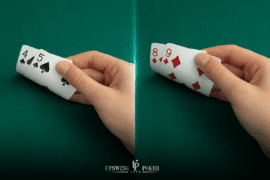
The game is six-handed with a $200 ante. Dwan is first to act from the Hijack with Js Jh and opens to $1,200. Garrett looks down at Ad Qd in the Cutoff.
He calls.
Ad Qd is obviously strong enough to 3-bet here, but Garrett’s decision has less to do with his hand against Dwan and more to do with who is sitting behind him.
Three of the four players left to act are players Garrett describes as ranging from “pretty good to incredible for the game.” In other words, these are exactly the players he wants joining the pot. By 3-betting, Garrett makes it substantially more difficult for them to continue. By calling, he leaves the door open.
Garrett considers this an important part of constructing his preflop strategy in live cash games.
“If they’re not in the pot preflop, they have no ability to make mistakes for hundreds of big blinds postflop,” he explains.
That doesn’t mean you should simply stop 3-betting whenever there are weak players behind you. Against someone as strong as Dwan, finding extra preflop flats creates a different problem. If Garrett never 3-bets from the Cutoff, Dwan can essentially play as though he has the Cutoff himself, opening with impunity knowing Garrett won’t punish his opens.
The protection is to retain a more polarized 3-betting range. Garrett can continue 3-betting hands such as AK and JJ+, while occasionally balancing those hands with weaker 3-bet bluffs, like suited connectors. Strong hands such as AQ suited can then move into the calling range when there are still weak players left to act.
There’s a useful side effect, too. When Garrett can show up with AQ suited and other premium hands after flatting preflop, his calling range becomes harder for elite players like Dwan to read.
That isn’t the primary objective, though, just a byproduct. The priority is simple: don’t automatically shut the weakest players out of the pot just because your hand is strong enough to 3-bet.
Everyone behind Garrett folds this time, and he goes heads-up with Dwan.
Flop: Don’t Make Your Hand Too Easy to Read
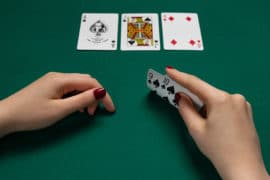
The flop comes Jd Tc 4h.
Dwan’s JJ has flopped top set.
Dwan checks and Garrett bets $1,500, roughly 45% pot. Dwan calls.
Garrett considers the flop quite favorable for Dwan’s range. He has every set, overpairs, JT offsuit, and plenty of strong Broadway combinations, so betting frequently would be perfectly reasonable.
Instead, Dwan checks.
There’s a broader strategic point here for both players. Against strong opponents, Garrett doesn’t want his betting and checking decisions to reveal the class and strength of hand he holds.
After Dwan checks, for example, Garrett would overwhelmingly bet his two-pair-plus hands. 55 through 99 naturally want to check more often. But against an elite hand reader, Garrett doesn’t want either category to become absolute. He can occasionally check strong hands and occasionally bet those medium pocket pairs so that seeing one action doesn’t immediately narrow his range to one type of holding.
Dwan appears to be thinking along similar lines with JJ.
Garrett believes Dwan should generally have plenty of check-raises on this flop, including strong made hands and draws. But top set is a reasonable candidate to slowplay because holding two Jacks blocks many of the J-x hands Garrett could continue with.
Garrett also suspects Dwan may simply be trying to make his range harder for Garrett to decipher.
That becomes increasingly valuable against opponents capable of accurately hand reading. Predictability makes their lives easier, and mixing in strong hands where they aren’t necessarily expected makes it harder.
Dwan calls, and they see a turn.
Turn: You Have to Find the Uncomfortable Bluffs
The Ks on the turn gives Garrett the nut straight.
Dwan checks again and Garrett bets $5,000, approximately 80% pot.
Garrett likes the large sizing. When he holds straights and strong two-pair hands, he wants to start shoveling money into the pot.
When it comes to finding bluffs to go along with strong value, Garrett identifies low A-x (particularly A2 through A5) as an important bluffing region. Those hands have very little showdown value and unblock weak hands like 66 through 99 that Dwan can still hold.
Other potential bluff candidates don’t have the same qualities.
This is exactly where Garrett thinks many players go wrong. They arrive on a scary, coordinated turn, look at a hand like A3 and conclude that it’s time to give up.

If you do that too often, your large turn bets contain far too much value. Opponents can easily and correctly fold a large portion of their range when you do bet, and you forfeit EV by not winning your share of pots when you don’t have a strong hand yourself.
Garrett believes the vast majority of players underbluff this type of texture. Finding uncomfortable bluffing combinations allows you to bet your strong hands aggressively without making your range transparently strong.
Dwan calls again with his set.
Then the river pairs the Jack.
River: Don’t Level Yourself Without Evidence
Dwan now has quads.
He checks for a third time.
Garrett bets approximately 150% of the pot with his straight.
This is the decision he likes least in retrospect.
Garrett was trying to create a leveling war. He thought Dwan’s range contained plenty of J-x along with hands like AT, KT and QT that could bluff-catch. By choosing such a big sizing, Garrett hoped Dwan might conclude that his range was essentially full houses or bluffs.
Maybe Dwan would believe Garrett would never value bet a straight for 150% pot, and maybe that would induce a hero call.
The problem is contained in all those maybes.
Garrett and Dwan hadn’t played enough hands together for Garrett to know that Dwan would actually react that way.
“If I’m being really honest with myself, I think I was just hoping that Dwan would call me too often,” Garrett says.
Compare that with his outstanding preflop adjustment. Garrett flats AQ suited because he has a concrete reason to deviate: weak players are behind him, and he wants them in the hand.
The river adjustment is based largely on speculation.
Garrett still prefers betting with his straight over checking it. Given his image and Dwan’s ability to make difficult calls, there should be value to be found. In retrospect, though, Garrett thinks something around pot would be better than the 150% overbet.
Dwan responds by raising to $68,000.
Garrett now has to decide whether one of poker’s most infamous and aggressive bluffers could be bluffing him.
Ultimately, Garrett comes back to the most important question: after he bets 150% pot on this texture and Dwan raises anyway, how often does Dwan actually have air?
Against most opponents, Garrett says the answer is effectively never.
His oversized bet has already represented enormous strength. When an opponent responds by raising that range, you need a compelling reason to believe they’re capable of finding the necessary bluffs.
Garrett briefly talks himself toward the heroic call, but eventually lets the logic win.
He folds, and Dwan’s quads win the pot.
It’s a great example of the line Garrett is constantly trying to walk between theory and exploitation. Adjustments can make you dramatically more profitable, but there needs to be something supporting them. Table composition gave Garrett a reason to flat AQ suited preflop. His lack of history with Dwan should have made him more cautious about trying to manufacture a river leveling war.
Garrett explores that psychological side of high-stakes poker in much greater depth in his upcoming book, Beneath the Cards, which is available for pre-order now.
And for the strategy behind decisions like these — from building preflop ranges around weak players to finding the bluffs required on intimidating board textures — Garrett goes much deeper in his upcoming Upswing Poker course, Destroy Live Cash.