How Timothy Adams Approaches Deep Stack Tournament Poker
Timothy Adams has spent years playing the toughest tournament fields in the world, and one thing comes through very clearly when he talks about deep stack poker:
Most players aren’t well-versed in deep-stacked early MTT play.
That’s a major theme throughout Modern Tournament Mastery, the new Upswing course from Timothy Adams and Daniel Dvoress. Modern tournament study tends to focus heavily on 20-40bb situations, ICM pressure, and short stack play, but Adams makes the point that the early stages still matter a lot more than they’re given credit for.
A lot of the adjustments he discusses in this video are subtle, but they change how entire hands and ranges function once you’re sitting on 150-200bb.
Here are five concepts from the course that stood out to me most:
- Building Early Chips Matters More Than People Think
- Deep Stack Poker Tightens Value Thresholds
- Nut Potential Starts Driving Preflop Decisions
- Reverse Implied Odds Become a Real Problem
- Turn Overbets Become Extremely Valuable
1. Building Early Chips Matters More Than People Think
One of Adams’ biggest points is that many tournament players are tightening up too early.
As ICM tools and adjusted ranges have become more common, players have started carrying that mindset much farther from the money than they probably should. Adams argues this often leads to medium stacks and shorter stacks giving big stacks way too much freedom to attack.
That creates a lot of incentive to build early.
If you can accumulate chips during the deep stack stages, you give yourself access to the kind of leverage that becomes incredibly powerful later in tournaments, especially against players who overfold because they’re trying too hard to preserve tournament life.
There’s also a practical point that Adams brings up:
A lot of strong regs skip early levels entirely because most modern study is centered around shallow stack and ICM situations. Meanwhile, if you actually show up on time, you’ll often find yourself playing short-handed against mostly recreational players at the start of major tournaments.
That’s a pretty good trade.

2. Deep Stack Poker Tightens Value Thresholds
One of the biggest adjustments Adams discusses is how much value thresholds tighten once stacks get deep.
At medium depths, players are comfortable stacking off with many hands that feel extremely strong. But at 200bb, having the actual nuts starts mattering a lot more.
That changes both preflop and postflop strategy.
Hands that feel great at 40-60bb often become much less comfortable when the SPR gets massive. Top pair hands, overpairs, and other strong but non-nutted holdings become harder to pile money into because future streets still carry so much risk.
As a result, deep stack poker often becomes more controlled than players expect.
That doesn’t mean passive. It just means mistakes get more expensive once pots start growing.
3. Nut Potential Starts Driving Preflop Decisions
One concept Adams spends time on throughout the course is how deep stack ranges shift toward hands that can win massive pots.
He gives the example that at 200bb deep, he’d often rather raise Ks 8s than Kc Jd from early position.
Kc Jd is obviously the stronger hand in a vacuum, but deep-stack poker isn’t only about raw hand strength. It’s about what kinds of pots your hand creates.
Ks 8s can make disguised flushes and nutted hands. Kc Jd mostly makes top pair.
And top pair just loses a lot of value once stacks get very deep.
It’s a small adjustment on paper, but it changes how you think about range construction once you move away from shallow stack poker.
4. Reverse Implied Odds Become a Real Problem
Of course, nut potential alone isn’t enough.
Adams spends a lot of time talking about reverse implied odds and how much more dangerous they become at deep stack depths.
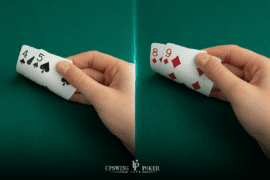
A good example is As 5s.
A lot of players see a suited wheel Ace and immediately think:
“This hand can make flushes and straights, so let’s open it.”
But deep stack poker punishes second-best hands extremely hard.
Your straight can run into a bigger straight. Your top pair can run into a better top pair, or a two pair can be dominated by a better two pair. And because stacks are so deep, those situations become expensive very quickly.
At 40bb, losing those pots hurts.
At 200bb, they can wreck your tournament.
That’s why deep stack preflop construction isn’t simply about adding more suited hands. You also have to think carefully about how vulnerable those hands are to making second-best holdings.
5. Turn Overbets Become Extremely Valuable
Another interesting section was Adams’ discussion of turn overbetting.
He uses an example where we raise Ac Jd from the cutoff at 200bb deep and get called by the Big Blind.
The flop comes:
Jc 7c 5h
At shallower depths, this is often a straightforward “bet big and play for stacks” situation.
But at 200bb, Adams explains that even strong hands like top pair/top kicker become more awkward because the remaining SPR is still huge.
Then comes the key adjustment.
A lot of players instinctively continue betting medium sizes on the turn, hoping to get three streets of value. Adams argues that this often doesn’t make much sense deep stacked because there simply aren’t many rivers where you’re comfortable reopening the action again.
So instead of spreading value across multiple medium bets, he often prefers front-loading value immediately with turn overbets like 150% pot or even 200% pot.
That allows strong hands to capture value immediately while also giving draws and semi-bluffs much more leverage.
He also talks about “demi-bluffs” or merge overbets, where hands like As 5s can aggressively pressure better holdings on that same J75 board while still retaining equity and showdown value. How comfortable does 88 or 66 feel on that board vs a 200% turn barrel?
It’s a very different way of thinking about turn play than what most tournament players are used to.
Final Thoughts
An interesting aspect of Modern Tournament Mastery is that Adams and Dvoress spend a lot of time explaining why deep stack tournament poker changes so much once SPRs get large.
They aren’t just showing solver outputs. They’re explaining how stack depth changes hand values, betting incentives, and overall strategy.
The course also includes extensive breakdowns of the Triton London 2023 Main Event alongside Stephen Chidwick, where they analyze hands from one of the toughest tournament fields in the world.
If you want to improve beyond standard shallow stack tournament strategy, there’s a lot that players can take away from this course.