How Timothy Adams Attacks from the Big Blind (And Why Most Players Don’t)
One thing that becomes very clear early in Upswing’s Modern Tournament Mastery is that while the course is built by both Timothy Adams and Daniel Dvoress, a lot of the most practical, in-the-weeds breakdowns come from Adams walking through spots on his own.
The video we’re going to look at today is one of those.
He spends this segment focused entirely on check-raising from the Big Blind and emphasizes how critical it is for your strategy to do this well. It’s framed as a core part of playing tough, aggressive tournament poker—something high-stakes players are consistently good at, and something most players are nowhere near executing well.
The flop isn’t the only part of a check-raised pot that matters. Turns and rivers are complicated and unintuitive, but that’s what makes nailing these spots so valuable.
This Problem Starts Before the Flop Is Even Dealt
When you defend the Big Blind versus a Cutoff open, you’re stepping into the hand with a range that is extremely wide by design. You must defend beyond the realm of human comfort. This means you’re going to miss a lot, and it means you’re going to have to fight back to avoid getting run over by the in-position player.
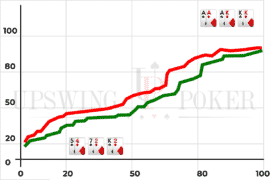
See below to get a handle on just how little folding the Big Blind is allowed to do against a Cutoff min-raise:

The Cutoff knows that, and in theory responds the way you’d expect:
- High frequency c-betting
- Lots of small sizing
- Very little checking back
They’re leaning into the range advantage and forcing you to play defense right off the bat.
If you just sit there and passively defend against their bets, the hand is basically playing itself from their side.
That’s the entire reason the check-raise matters as much as it does.
If You Don’t Check-Raise Enough, You’re Making Life Easy
Adams makes this point pretty clearly, even if he doesn’t overstate it: population does not check-raise enough here. Not even close.
Especially against small c-bets, most players default to calling too often and raising too rarely, which lets the in-position player run a very clean, very efficient, and cost-effective strategy. Bet small, pick up folds, over-realize your equity, and move on.
Once you start check-raising at something closer to the correct frequency, that stops working quite as well.
Now the Cutoff can’t just fire with their whole range. Now they have to think about which hands can actually continue. Now some of those easy bets start mixing into checks. Now they’re the ones dealing with uncertainty.
Aggression from the Big Blind is what forces the in-position player to make tough decisions and compromises.
The Tradeoff That Most People Miss
Adams emphasizes this point, and it’s a critical one.
If you check-raise aggressively on the flop (and you should be doing it more than you probably are), you’re pulling strong hands out of your calling range. So when you do just call, your range is weaker. There’s nothing wrong with this; it’s just how the strategy works.
It does mean you have to be aware of the implications for both players, though.
You’re going to get to turns and rivers with hands that don’t feel great. Second pairs, weaker top pairs, stuff that feels like it wants to fold somewhere. And if you don’t understand how your range is constructed, that’s exactly what you’ll do.
As Adams explains:
And in my experience, population does overfold these hands, not really understanding where they’re at in their range.
They don’t realize that once you’ve removed a lot of your top pair from your range by check-raising earlier, the hands that remain have to pick up the slack. You don’t get to just fold everything that feels marginal, because marginal is now a big part of your range.
What the Strategy Actually Looks Like
At a high level, none of this is especially mysterious, even if it’s hard to execute in-game.
Against small c-bets, the Big Blind is check-raising a lot more than most players think. You’re not just defending, you’re actively pushing back. This is often somewhere in the 20–25% range across all flops, with certain textures going even higher.
See below for a look at how the Big Blind defends against a small c-bet on J54 rainbow:

Value hands are fast-playing more often than people expect, especially at shorter stack depths. If a hand is strong enough to build a pot, you’re usually just building it right away.
Around that, you’re filling in with hands that can generate folds but aren’t dead when called. Straight draws, backdoor-heavy combos, hands that can continue barreling on good turns.
And then there’s the part that always feels a little uncomfortable: the hands that don’t look like much, but still end up in the check-raise range. The “dusty” stuff like bottom or second pairs, check-raising for equity denial and seeking good barreling opportunities.
Where This Becomes Immediately Profitable
In theory, once you check-raise, the in-position player is supposed to continue quite a bit, especially versus smaller check-raises.
In real games, players overfold. Pretty significantly in a lot of pools.
They don’t defend enough of their range, they don’t push back often enough, and they let the Big Blind get away with a level of aggression that shouldn’t really be possible if they were playing correctly.
So the adjustment ends up being pretty simple: You check-raise more.
You don’t wait around for perfect hands. You recognize that the pool isn’t responding the way it should, and you start applying pressure more often across your entire range.
The Part That Actually Takes Work
None of this is hard to understand conceptually. The hard part is getting comfortable once the hand goes past the flop.
Many players pull back from doing the uncomfortable thing and check-raising combos that are unfamiliar to them. They’ll find the check-raise, get called, and then on the turn they’re not really sure what their range looks like anymore. The river comes in, and now they’re guessing.
Adams’ approach here is pretty straightforward: you don’t avoid those spots. You put yourself in them on purpose.
As Adams puts :
When you become really good, it’s good to get in complicated nodes. You’re going to put your opponents in a bunch of difficult spots. You want to be that person that’s really hard to play against.
Run drills in Lucid Poker. Force the check-raise lines. Play through the turn and river even when it feels uncomfortable. The goal isn’t to be perfect right away, it’s to stop those nodes from feeling unfamiliar.

Once you’ve seen them enough times, the decisions get a lot easier and more intuitive.
The Bottom Line
If you’re not check-raising enough from the Big Blind (especially against small c-bets), you’re making the game easier than it needs to be for the player in position.
You’re letting them run a simple strategy, avoid tough spots, and control how the hand plays out.
The strongest players don’t allow their opponents to dictate terms. They push back early, they stay aggressive on later streets, and they’re comfortable playing hands that don’t look obvious on the surface but make sense within the overall strategy.