The Biggest Mistakes Hold’em Players Make in PLO Tournaments (and How to Fix Them)
PLO tournaments have one of the biggest edges in poker.
Prize pools are growing, fields are soft, and on the surface the game looks like Hold’em with two extra cards. That last assumption is exactly why the fields stay soft.
Two-time bracelet winner Dylan Weisman recently sat down with Brad Owen, one of the most popular Hold’em pros in the world, to review Brad’s play in a ClubWPT Gold PLO tournament. Brad is a sharp NLHE player, and Dylan still caught him using Hold’em logic that quietly burns equity in PLO. The mistakes below come straight out of that session and Dylan’s full course, Crushing PLO Tournaments, which just launched on April 20th.
In This Article
Three Hold’em Instincts You Need to Unlearn
The mistakes we’re about to walk through all trace back to the same root cause: Hold’em instincts that are correct in two-card poker and wrong in four-card poker. Before we get into each one, here’s the short version of what changes.
#1 “Raise your big pairs.”
In Hold’em, pocket kings and queens raise by default. In PLO, a pocket pair with bad side cards is a totally different hand from the same pair with good side cards, and auto-raising the weak versions is one of the fastest ways to spew chips preflop.
#2 “Min-raise could still be top-of-range”
In Hold’em, a 2-2.5x open is standard, mixing strong and weak hands to stay balanced. In PLO tournaments, recreational players almost always use min-raise for their medium hands and pot for their premiums, which means the min-raise range is capped and ripe to be attacked.
#3 “Bet small on the river for thin value.”
In Hold’em, a 25% pot river bet gets paid by players who don’t xr bluff enough to punish you. In PLO that bet is a trap. B50 is the minimum.
Three instincts, three mistakes. Here’s how to fix each one (plus a bonus mistake.
Preflop
Mistake #1: Raising Bad Big Pairs Too Aggressively
Pocket kings in Hold’em are a default raise. In PLO, Dylan calls them “one of the most misplayed hand classes” in the game. The problem isn’t the pair. It’s the side cards, and the answer changes with stack depth.
There’s a world of difference between double-suited kings with connected side cards like K♠K♣6♠7♣ (a monster that pots almost always) and rainbow kings with two danglers like K♠K♥3♦8♣ (a hand that gets crushed when you auto-raise and face a three-bet). Same hand class, wildly different actions.
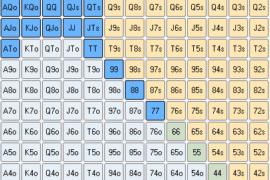
It gets more stark as stacks shorten. Off 35bb, Dylan’s framework raises pocket jacks only about 7% of the time with a single-suited variant, and 23% even double-suited. The rest limp, because at shallower stacks there’s no room to navigate a three-bet pot comfortably. The same logic pulls lower pairs like 99, 88, 77 out of your raising range almost entirely unless you have ace-high suit and connected side cards.

“If your open feels bad to get three-bet, you just don’t open it.”
Dylan’s rule is one of the tidiest heuristics in the course. Use it as a gut check before every big-pair open.
The Fix
Before opening any big pair, ask Dylan’s question: if I get three-bet right now, will that feel bad? If yes, limp. If no, pot.
- ✓ Double-suited kings, connected side cards (K♠K♣6♠7♣) → pot at every stack depth. Wants a bigger pot.
- ✓ Rainbow kings, two danglers (K♠K♥3♦8♣) → hates getting three-bet.
- ✓ Pocket queens, no ace → mostly limp. Can’t comfortably call a three-bet when villain could have aces.
- ✓ Pocket jacks at 35bb, single-suited → limp about 93% of the time. Raise only with double-paired or tightly connected side cards.
- ✓ Pocket tens and below → limp by default. Raise only the polar combos like A♠T♠T♣9♣ from late position.
- ✓ Double-suited aces → limp 100% from UTG at 100bb. Build a limp-three-bet range around them.
Note: Our new PLO trainer in beta is a great place to start drilling these preflop and postflop spots too. Beta access to the trainer comes with the course.

[PREFLOP 100BB LESSON PREVIEW]
Preflop
Mistake #2: Treating a Min-Raise Like a Normal Open
In Hold’em, a min-raise is often balanced: strong hands mixed with weaker ones to keep you guessing. In PLO tournaments, it’s almost never balanced. Dylan calls it “one of the biggest population exploits I use in all of PLO tournaments.”
The reason is how most recreational players build their ranges. They use two sizings, pot and min-raise, and they don’t balance between them. Aces and premium pocket pairs get potted. Hands they know they shouldn’t limp but don’t want to fold get min-raised. That means the min-raise range is missing all the best hands. No aces, usually no kings, often no ace-x-x-x combos at all. It’s capped.
Most Hold’em players see a min-raise as SOP. Dylan sees a min-raise in PLO and thinks attack. Because the opener is capped, you don’t need a polar three-betting range with bluffs mixed in. You want a linear three-betting range built around pure equity: double-suited broadways, ace-king-x-x combos, connected rundowns. You’re not representing. You’re leaning on a hand that actually has the best of it, against a range that doesn’t.
The Fix
Stop treating a min-raise like a discounted open. Treat it like a limp that happens to cost a bit more.
- ✓ Fold your junk → the cheap price is a trap. Calling wide gives the capped opener a chance to outflop you; implied (and reverse implied) odds are important.
- ✓ Three-bet linear → attack with your strongest equity hands. Double-suited broadways, A♠K♣J♠T♣ type combos, connected rundowns.
- ✓ Skip the bluffs → no need for polarity when villain’s range is already capped. Pure value works.
- ✓ Watch for tells → if a player uses min-raise at one point and full pot the next, that’s confirmation that they are splitting their range and sizings are mapped to hand strength. Exploit accordingly.
“Pot limit Omaha tournaments were going to be one of the most lucrative forms of poker, and so I started dedicating essentially all of my time to building Sims and looking at populations and doing everything I could to maximize my win rate playing these tournaments. This course is the culmination of all of that work.”
— Dylan Weisman
River
Mistake #3: Using B25 on the River In Position
In Hold’em, a 25% pot river bet is a legitimate value-extraction size. It’s how you get paid by one-pair hands, how you induce light calls, how you keep the pot manageable against a range that can’t raise you very often. A lot of Hold’em players bring that habit straight into PLO. Dylan shut it down during the Brad Owen session as clearly as he shut down anything in the whole coaching call.
“B25 is not a thing. In position on the river, we never use B25 in PLO. B50 is your smallest sizing.”
— Dylan Weisman
The reason is how equity-dense PLO ranges are. Even on rivers, villain’s range is loaded with hands that have enough equity to raise against a tiny sizing. A B25 river bet in position invites a check-raise from combinations that are essentially indifferent to your sizing, which means you face a brutal fold-or-call decision with a bet that was meant to be safe. Dylan’s follow-up rule is surgical: “If you have a combo that doesn’t want to B50, you should just check it back.” There’s no in-between. Either your hand is strong enough to B50 and call a raise, or it belongs in your checking range.
The Fix
- ✓ In position on the river, never B25. B50 is the minimum.
- ✓ Use B50 with hands that can stand a check-raise. Straights that block other straights, sets on unpaired boards, second-nut hands with blockers to the nuts.
- ✓ Can’t stand a check-raise? Check back. There’s no cheaper value bet to fall back on in PLO.
- ✓ Quick gut check → if you’d fold to a pot-sized raise, you shouldn’t be betting in the first place.
Flop
Bonus Mistake #4: Overusing Full-Pot Sizing Postflop
We covered this one in more depth last week in Play More Hands, Win More Pots: 5 Tips for PLO MTT Success, but it deserves a callout here because it’s the single most common postflop sizing leak an NLHE player brings into PLO. Hold’em players are taught that betting big gets value and protects equity. In PLO, full-pot c-bets are a specialty tool, not a default.
At deeper stacks, B25 or B33 is the right c-bet on most textures, keeping your range wide and leaving you two more streets to play. There’s one exception: forcing indifference. On boards like Jack-four-three or seven-four-deuce two-tone, a full-pot lead into pocket queens with no backup feels terrible for the defender. Drop that to B33 and it’s an easy call. That’s the only reason to full-pot at deeper stacks.
The Fix
- ✓ Deep-stack flop c-bet default → B25 or B33.
- ✓ Full pot → short-stack commit spots, or deep-stack textures like Jack-four-three where it forces indifference.
- ✓ Rule of thumb → record your full-pot bets during a session and verify each spot. You are probably overdoing it.
Key Takeaways
Big pairs need good side cards. If a 3-bet feels bad, limp instead of raising.
A min-raise is capped. Attack it with a linear 3-bet range — no bluffs required.
B25 river bets don’t exist in PLO. B50 is the floor — if you can’t handle a raise, check back.
Full-pot c-bets are a specialty tool. B25–B33 is your deep-stack starting point.
The Good News: PLO Tournaments Are Still Soft
Players still raise hands that should limp, full-pot when they should size down, and defend big blinds like it’s a cash game. Even at high-buy-in events, fundamental ICM errors are the norm. But that window won’t stay open forever. As solver-backed frameworks spread, the edge shrinks. Early adopters are already cleaning up.
Why Dylan’s Framework Matters
Success in NLHE doesn’t guarantee success in PLO. Your Hold’em habits can actively be liabilities. The good news: PLO tournaments reward preparation more than raw talent. You don’t need to spend thousands of hours in the solver yourself. You just need the framework from someone who already did.
Dylan Weisman spent five years and over a thousand hours building Crushing PLO Tournaments, an eight-module course covering preflop ranges at every stack depth, a full ICM section built on sims no other course offers, postflop heuristics for single-raised and multiway pots, and complete final-table reviews from his Triton, WSOP and PGT runs.
Now Available
Crushing PLO Tournaments is ready.
Your edge starts here.
Check out Crushing PLO Tournaments and see why high-stakes legends like Brian Rast and Erik Seidel trust Dylan’s approach. Lifetime access, PLO Trainer App access, and a launch-week bonus package if you act before the window closes.