Garrett Adelstein Analyzes a Massive Bluff Gone Wrong
In today’s article, we’re going to get Garrett’s perspective on a hand he played on High Stakes Poker against and Daniel Negreanu. If you’d like more poker insights and want to delve further into Garrett’s mindset, you can preorder his book, Beneath the Cards.
They’re playing $500/$1,000 with a $1,000 big blind ante, beginning the hand with $219,000 effective stacks.
Preflop Action
Garrett Adelstein opens to $3,000 (3x) from the hijack holding Ac 7c. Daniel Negreanu 3-bets to $10,000 from the cutoff. Action folds back to Adelstein, who 4-bets to $40,000.
Preflop Analysis
“We’re playing with a one big blind ante, and I have a suited ace, so it’s a clear open. I typically use a 3x sizing with this ante. A 2.5x sizing is also a viable option, but most of the games I play in (this one included) are soft enough that getting that extra half big blind in there is going to show a bigger profit. I’m also not going to deal with 3-bettors nearly as often as I would if everyone was theoretically sound preflop.
Once DN 3-bets to $10k, I think folding is best. The spot is close between calling and folding in this configuration (hijack versus cutoff), but I think folding is best against what I suspect is a somewhat snug 3-betting range from DN.
Instead, I ended up impulsively 4-betting. A few hands earlier, I saw DN show down a suited connector after 3-betting preflop, and I probably got a little trigger-happy after seeing that. In hindsight, seeing that showdown should probably make me lean toward DN having a strong hand pretty often here. Leveling games aside, this is just bad.”
Flop Action
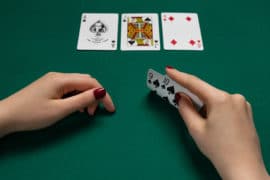
The flop comes 5d 5s 3d. Garrett checks. Negreanu checks back.
Flop Analysis
“I suspect DN’s range is super strong here, maybe something like ace-king offsuit (AKo), ace-jack suited-plus (AJss+), and pocket pairs like pocket nines-plus (99+). Against that range, ace-seven of clubs (Ac 7c) is in trouble.
This is such a slam-dunk spot, out of position and without backdoors, to just pure give up. Although I’m almost never going to win at showdown if the hand checks down, I still have plenty of weaker hands like suited connectors and suited broadways that are better candidates to bluff with by the river.
In short, my thought process was simple: if my hand doesn’t improve, I’m not putting any money in this pot.”
Turn Action
The turn is the 5c. Garrett checks. Negreanu checks back.
Turn Analysis
“Given the flop analysis, this is the worst card in the deck. I’ve now done a very poor job of repping queens-plus (QQ+), which is what I’m trying to represent after 4-betting preflop.
DN’s check-back is fine. And I suspect he protects his range well here against a winning player in this huge game. I still think he has nines through queens (99-QQ) here a lot. And I suspect most of his big aces check a ton as well. Essentially, my flop logic carries over.”
River Action
The river is the 6s. Garrett moves all-in for roughly 2.2x pot, jamming $179k into $82.5k. Negreanu doesn’t take much time before calling.
River Analysis
“With exactly two aces that didn’t need protection on early streets, this line is certainly viable. It’s one I’ve taken in-game a few times. If I do bet here, with aces or a bluff, the sizing needs to be this overbet shove.
But for leveling reasons, this is simply awful against DN. The worst. For this bluff to get through, I would need him to believe something like ‘From a GTO perspective, Garrett knows that aces occasionally take this line.’ Or I would need him to think that my line looks so insanely bluffy that a strong player would never bluff here. Those are the types of leveling dynamics that would make this play reasonable.
But I think the opposite is true here. I’d been bulldozing over the table all session. DN also probably figured from highlight hands that I love putting people to the test. He’s also not exactly known for being a big hero folder. So from a psychological standpoint, this is just gross.
The craziest part is that I actually thought about all of this on the river before I acted. I’d already decided that I needed to check again.
And then, the next thing I knew, I was all-in.
It was bananas. I’ve played a few hands like this in my career—where you just black out and your brain short circuits. The moment I put the chips in the pot, it was like waking up from a drunken stupor. I knew immediately this was never going to work.
Some players might look at this hand, run it through their solver, see it’s a thing, and then move on. But I take a lot of pride, and hopefully capture a lot of EV, from winning the leveling war.
But this—this was terrible. Terrible fucking poker.”
Conclusion, from Garrett’s book:
The $440,000 pot was a trainwreck, maybe the worst hand I’ve ever played. My performance wasn’t any better over the next two days as I struggled to let the disastrous hand go.
Once day three wrapped, I was fortunate to have only lost about $400,000, given the massive stakes we were playing for. What bothered me most wasn’t the evaporated cash, though. It was my lack of execution on the biggest stage in poker.
It felt like a rebroadcast of my Survivor debacle.
All these viewers think I’m the best, I thought to myself. Yet here I am, giving my chips away when the bright lights are on. I’m such a fraud.
Throughout my livestream career, so much of my identity had been derived from projecting an image of being a top no-limit player. If I was no good at the one thing I’d spent most of my life obsessing over, then who was I? What did I even offer to the audience—or the world?
I’d been running from imposter syndrome my whole life, attempting to overcome my incessant self-doubt through sheer will. But poker doesn’t work that way. No matter how hard you prepare, you’re not always going to play your best.
Sometimes you’re going to bring your C game. And sometimes you’re going to lose even when you bring your A game.
When a seat opened, host Brent Hanks offered to get me in for the final day of filming. It was a game worth around $50,000 in expected value assuming I was in the right headspace. But with my confidence shattered and my brain in disrepair, I declined. Instead, I got plastered over dinner and wine with Tom Dwan and another friend, flew home hungover the next morning, and fell into a deep depression.
I quickly gained fifteen pounds, lying in bed and eating everything in sight for the next two weeks—doing the same destructive shit I thought I’d overcome.
After five years of successfully managing my emotions on and off the table, the relapse was scary. I eventually recovered by exercising, spending time with friends, and deconstructing my irrational thoughts with my wife. Still, I refused to go on a livestream for two months, unwilling to be on camera until I dropped the weight.
I was still trying to play the role of the perfect guy, even if only subconsciously. I had no issues talking about my former weight fluctuations because I was in great shape nowadays. I was content discussing how I used to be a complete tilt monkey because I was emotionally stable now. I felt safe mentioning my past mental health struggles because they were just that, in the past. In reality, after bombing on HSP, my psychological well-being went from robust to anemic in an instant.
It was all just vulnerability theater. Just like I projected an image to get paid off in big poker hands, I was lying to the world—and myself—by pretending my problems were behind me.
Depression wasn’t in the rearview. I didn’t have it all figured out.
Want to Read More About Garrett’s Tumultuous Career?
If you liked Garrett’s hand breakdown, you’re going to love what’s coming next:
In his upcoming book Beneath the Cards, Garrett Adelstein reveals all about the cost of competing at the highest levels, what happens when your system breaks under pressure, and what it takes to rebuild in the aftermath. The book dives into several of the most pivotal pots of his career, how poker affected his life far beyond the table, and what happens when winning is no longer enough.
Preorder Beneath the Cards here.
By the way, Garrett is also teaming up with Upswing Poker to create a brand-new Destroy Live Cash course coming this fall, where he’ll break down 50 of his most strategically absorbing livestream hands. For those looking to level up their no-limit game, Destroy Live Cash distills Garrett’s decades of study and live experience into over 35 hours of in-depth yet easily digestible instruction. More details coming soon.