
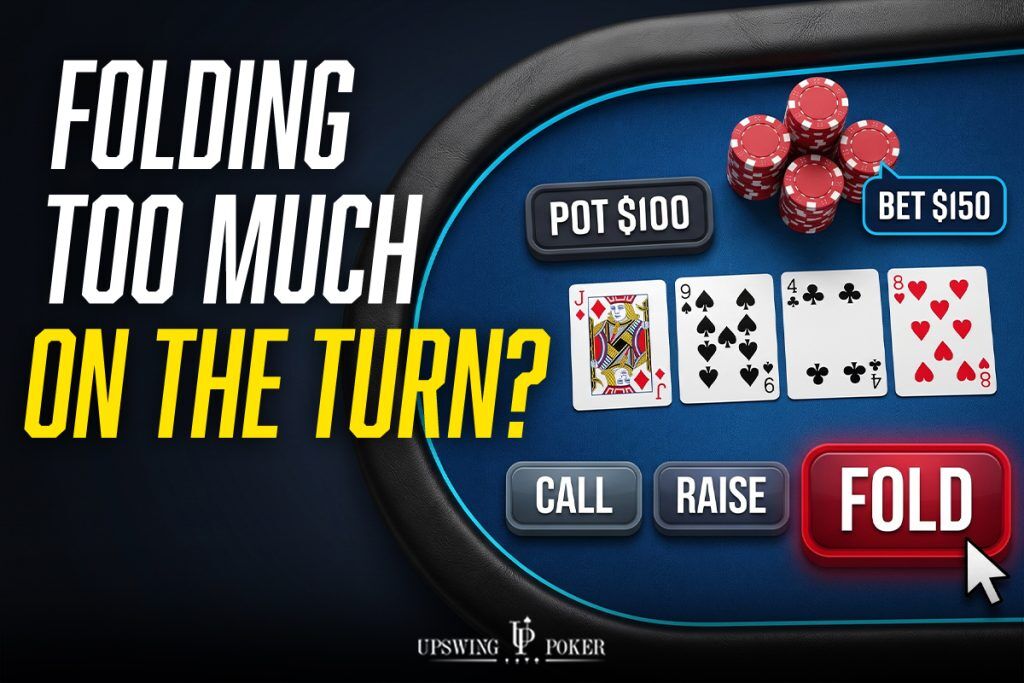
Calling a flop c-bet with a decent pair is usually straightforward. When your opponent follows up with a big turn bet, things get dicey. You may already be behind or even dead, and calling could mean facing an even bigger bet on the river.
In his video on facing turn c-bets in the Upswing Lab 2.0, Tim Jenkins explains how to approach these spots from the Big Blind. He starts by looking at which turn cards favor you and which favor your opponent.
Here are five lessons from that discussion.
1. Look for donk bets when the turn favors your range
You don’t have to check to the flop c-bettor every time you reach the turn after calling. If the turn improves your range much more than your opponent’s, leading (also called donking) can make sense.
A typical example is a turn that pairs the middle card after you check-call a large flop c-bet. You’ll often have called with plenty of middle pairs, very few of which your opponent will have c-bet that size with. When trips make up a much bigger part of your range than your opponent’s, you can start looking for donk bets.
That advantage can support a small donk bet across a variety of hand classes. Alongside your strong hands, some weaker pairs can bet for thin value or protection, while selected draws and weak hands comprise the bluffs.

2. Look for raises when the turn improves your range
Turns that improve your range also give you a reason to consider check-raising.
Take a flop of Jd 9s 4c followed by the 8h on the turn. QT and T7 now make straights, while J8 and 98 improve to two pair. You will likely arrive here with straights like QT and T7, along with two-pair hands like J8 and 98. That gives you potential value raises, though the weaker hands still need to be assessed against your opponent’s betting range.
A word of caution, however: your opponent can have QT too, so you still need to consider which hands both players get here with before assuming the turn favors you.
Learning from this post? Join the community and get full access to Lab 2.0 content.
3. Know which hands your opponent bets for value
Tim’s advice here is straightforward:
“Never fold if beating value.”
The trick is knowing what counts as value in the spot you’re playing. A good opponent’s big turn bet can often include one-pair hands. If you assume every large bet means two pair or better, you’ll throw away hands that should continue. That can lead to some expensive folds against players who know how to value-bet thinly.
Imagine your opponent uses a big overbet size for value with top pair and a weaker kicker than yours (which they should in many cases). Your hand now beats some of their value, as well as their bluffs. Bluff catchers can be folded at some frequency, even at full frequency against players who don’t bluff enough. Against a well-constructed betting range, however, hands that beat some of those value bets should generally continue.
Treat Tim’s rule as a reasonable and straightforward guideline against a well-constructed betting range, and bear in mind how strong your opponent’s turn betting range actually is.

4. Avoid overfolding against turn barrels
Tim points out a critical distinction between the flop and turn: compared with the flop, the turn is a spot where we rarely want to overfold relative to minimum defense frequency (MDF).
On the flop, the Big Blind has a wide range and must play the rest of the hand out of position. Folding more often than a simple MDF calculation suggests can be correct because of these factors.
Your flop call has already filtered out much of the weakest part of your range. If you routinely abandon what’s left to a second barrel, an aggressive opponent can run you over.
That doesn’t mean every flop call commits you to a turn call with any piece of the board. The turn card and bet size still determine which hands continue, and MDF is a more of a reference point than an exact quota on every board.
There’s also an obvious exploitative exception, as expressed earlier: if your opponent doesn’t bluff enough, fold more. You don’t need to pay off a value-heavy range to prove you can defend.
5. Prioritize outs when you only beat bluffs
Against a big, polarized turn bet, two hands can both beat all the bluffs and lose to all the value. In that case, the hand with more ways to improve can be the better continue, even if it looks weaker at first glance. This means second pair can sometimes be a better continue than a higher pocket pair.
Take Ks 9d 4c 2h. Against AK, Q9 has five winning river cards: the remaining nines and queens. TT has only the two remaining tens. TT is the stronger made hand now, but Q9 has more equity against that value hand.
Blockers matter too, including whether you remove likely bluffs. But a useful blocker or a few outs isn’t a free pass to call any size.
For the full breakdown, watch Tim Jenkins’s video on facing turn c-bets in the Upswing Lab 2.0. Work through the hand examples and Lucid Poker drills with these ideas in mind, paying particular attention to your weakest calls and the hands that work better as raises.
To learn more about how to play the flop, read: 3 Flop Mistakes You’re Making Without Knowing It.

Was this article helpful?
One tap. It helps us decide what to write and update next.


Poker Strategy
3 Common Spots Where Poker Players Aren’t Aggressive Enough
Advanced Poker Strategy Articles
Garrett Adelstein Had the Perfect Bluff-Catcher. He Folded Anyway.
Poker Strategy
Single Board Bomb Pots – The Complete NLH Strategy Guide
Poker Strategy
3 Adjustments That Make Your In-Position 3-Bets More Profitable
Poker Strategy
Lose Less, Win More: The Fundamentals of Big Blind Defense

Poker Strategy