Aces vs Kings, 500 Big Blinds Deep: Can Garrett Get Away?
By Duncan Smith · Online Cash Game Pro
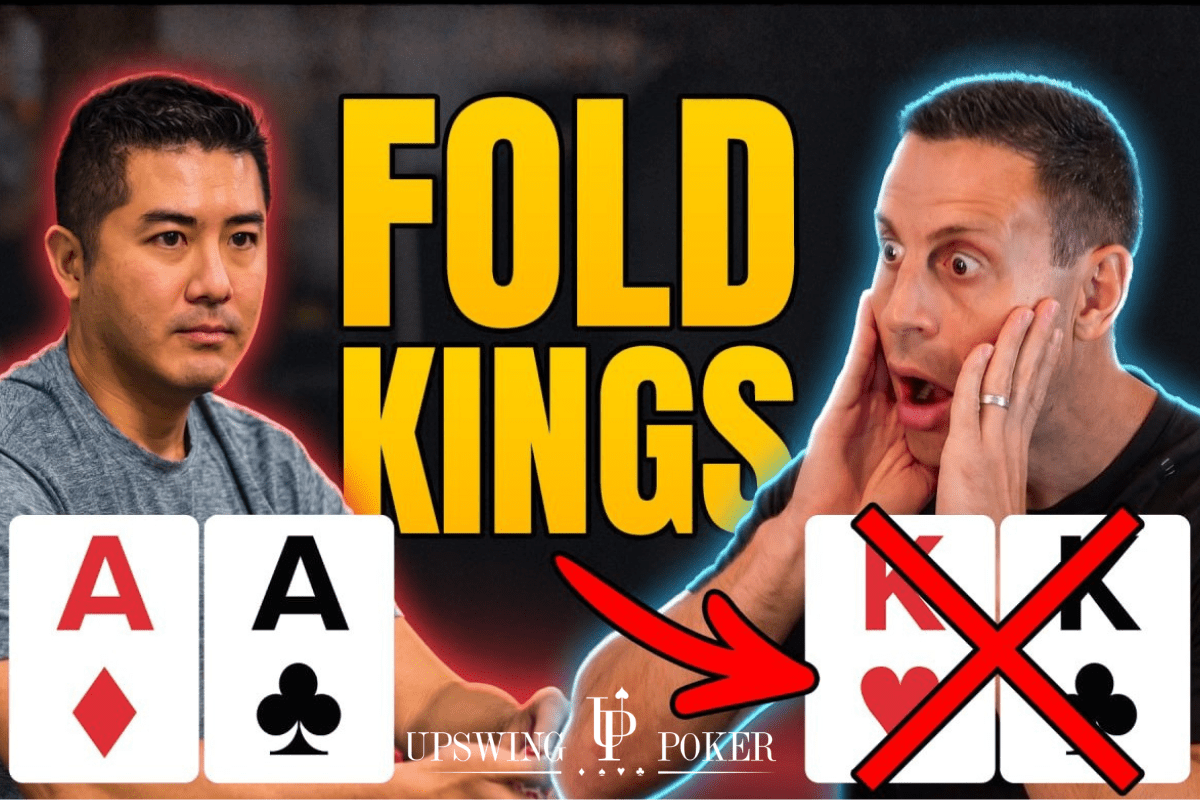
Garrett Adelstein has Kh Kc in a 4-bet pot; the flop comes 9-high, and there are no real draws to speak of.
For most players, that’s all that needs to be said. The money is going in, and a cooler in a 1,000bb pot is inevitable.
But this hand against Andy Tsai is a good example of why you should think beyond your hand’s absolute strength. Kings are obviously near the top of Garrett’s range here. What’s more important, though, is whether Andy can actually have enough worse hands (or enough bluffs) to justify putting another enormous chunk of money into the pot.
By the time Garrett faces the final decision, he no longer thinks that’s the case.
Know Your 4-bets and 5-bets
The game is $25/$50/$100 with a $50 ante, and the effective stacks are close to 500bb.
Gal Yifrach opens the action to $300 from early position, Andy 3-bets to $900 with Ad Ac, and Garrett cold 4-bets to $3,000 from the Button with his KK. Gal folds, and Andy makes the call.
Garrett doesn’t love Andy’s overall approach here, largely because Andy was fairly active with these 3-bet isolations, while also using a small size given the stack depths in play at the table.
Garrett does think Andy should have a 5-betting range here, although that doesn’t make flatting aces a mistake. In fact, Garrett thinks sometimes trapping aces is perfectly reasonable, particularly this deep against strong opponents.
Having no 5-bet range at all is the mistake.
“Do not be the guy who only calls with 99 through QQ here and nothing else.”
Andy’s 4-bet calling range should still be fairly tight, but Garrett believes a range consisting almost exclusively of medium and high pocket pairs is insufficient. Hands like suited Broadway cards, ace-king offsuit, and even a small number of suited connectors or lower pairs can all make sense. Some hands can be 3-bet with the specific intent of calling a 4-bet every time.
Garrett applies the same idea to his own 4-betting range:
“Do not be the guy who only 4-bets A4 and A5 suited here and nothing else.”
A5 suited may be one of the obvious bluffing candidates in a 4-bet range, but Garrett doesn’t want to stop there. Offsuit Broadway, suited connectors, and some suited kings can all be mixed in at low frequency, even at these stack depths.
This isn’t intended to turn preflop in live poker into a solver exercise. It’s to avoid becoming so predictable that a good opponent can immediately narrow your range to a few obvious hands.
Kings Look Great on the Flop
The flop is 9d 5h 5c.
Andy checks, and Garrett bets $3,000 into $6,525.
Garrett expects to bet this board at a very high frequency after 4-betting. His range is strong, the board is extremely dry, and kings look like exactly the kind of hand he wants to start building a huge pot with.
Then Andy check-raises small, to $8,400, and alarm bells start going off.
Against an opponent with a 5-bet range, you could discount some combinations of aces and kings, or even all combinations. However, given Garrett’s belief that Andy doesn’t have a 5-bet range, that doesn’t apply here.
He knows Andy can have all six combinations of aces here.
However, it’s too soon to start thinking about folding. Garrett is getting a great price, Andy could be bluffing, and it’s possible he could have worse for value like QQ-TT.
So Garrett calls the raise.
He doesn’t see much value in 3-betting the flop. He may fold out Andy’s worse value hands, while Andy’s strongest hands are perfectly happy to keep piling money in if Garrett reopens with a raise. Calling also gives Garrett another street of information.
Getting Double Check-Raised With Pocket Kings
The turn is the 3s, and Andy checks again after check-raising the flop.
Garrett bets $6,000 into the pot, now worth $23,325. There’s value in this bet, since Andy can still have plenty of worse overpairs, but Garrett also doesn’t want to give a free card to something like AK or AQ after the unusual flop action.
Andy then jams over Garrett’s turn bet for almost another $30,000.
This changes the whole equation for Garrett.
The important question is no longer, “How strong are kings?” Instead, it’s “What bluffs does Andy have?”
Garrett’s answer is basically none.
This is the issue with Andy’s line. Garrett doesn’t object to the turn check by itself. Strong hands do need to check sometimes, even after taking an aggressive action on the previous street.
But if you check-raise the flop and then check-raise again on the turn only when you have the goods, you’ve created an overly strong line that good opponents can simply stop paying off.
Garrett’s point here applies beyond this hand. If you want to use an unusual value line against strong opponents, you need some way to support it with bluffs. If you know you’re never going to find those bluffs in practice, it may be better not to take that value line at all.
Can Andy Ever Do This With Worse Value?
Before actually folding kings, Garrett still has to answer one more question:
Could Andy simply be overplaying worse overpairs for value?
Against many opponents, that possibility would be enough to call. Garrett is very clear about that. A recreational player might take this line because he has an overpair and doesn’t know what else to do. Someone else might simply be clicking buttons.
Against these opponents, it’s better to just lose sometimes when your opponent has you beat than to risk folding the best hand.
Andy is different because Garrett has so much history with him.
He has played with Andy for years, on stream and off it, has studied his tendencies, and feels extremely confident that Andy is almost never taking this particular line with queens, let alone jacks or tens.
Once Garrett removes those hands, Andy’s range starts looking very ugly for Kh Kc.
The value hands beat him, the worse made hands barely exist, and Garrett can’t find the bluffs.
At this point, against an opponent you know exceedingly well, just having kings isn’t enough to stack off.
When an Unusual Line Is Actually Just the Effective Nuts
Garrett finishes with a useful way of separating different player types in spots like this.
When a bad player takes a line that makes no sense, calling can often be right because bad players do things that make no sense. They overvalue hands. They click buttons, not knowing or caring what the right action is. They show up with hands you never would have put in their range. You generally can’t hero fold very strong hands against a bad player.
A decent reg can be a different story.
That player often knows his line looks suspicious. In some cases, that’s exactly why he chooses it with a monster. He expects you to look at the action, decide it doesn’t make sense, and pay him off. “This looks bluffy” is a justification regs have been using as long as poker has existed.
Garrett believes he has made a lot of money over the years doing the opposite.
The very best players are hard to play against because they can find the bizarre-looking value line and the bizarre-looking bluff. You can’t just chalk a weird line up to value because bluffing is hard when you’re playing a world-class opponent.
Andy, in Garrett’s view, wasn’t doing enough of the second part.
That’s why this hand is more useful than a simple highlight-reel fold. Garrett didn’t fold because he suddenly decided pocket kings were no longer a strong hand. He folded because years of experience playing with Andy made Andy’s range completely transparent, to the point where neither worse value nor bluffs could exist.