Timothy Adams Breaks Down ChatGPT’s Poker Logic
Timothy Adams and Mike Brady recently sat down to review a handful of hands played by Mike’s friend Stu, and alongside their breakdown, they had ChatGPT’s analysis of each hand pulled up and worked through both in real time.
What you get is a side-by-side look at how strong players actually think through spots, compared to large language model (LLM) chatbot analysis that feels polished and structured but doesn’t always line up with how the hand plays out.
This video also works as a nice preview of Tim and Daniel Dvoress’s upcoming Upswing course, Modern Tournament Mastery.
To be fair, the analysis doesn’t always miss. Sometimes it gets quite close, although being close but a bit off can be more dangerous than just being miles away from the point.
They also discover that most of the analysis is often pretty close to a word salad, since ChatGPT doesn’t actually understand poker; since ChatGPT is working from patterns rather than understanding.
As Tim and Mike go deeper into each hand, you start to see where things are off-base.
It turns into part strategy session, part roast, and a very clear look at what separates top professional thinking from surface-level explanations generated by an LLM.
Let’s go through the hands, which you can find below:
Hand 1: Saying the Right Words vs Making the Right Point

Preflop is standard, and both are fine with how things start.
On this flop, the Big Blind donk leading into two players isn’t something you expect from a studied player, but once it happens, the adjustment is straightforward. Calling makes the most sense, and this is one of the spots where the analysis lands on the correct action.
The turn is where things begin to slip.
The raise gets described as “denying equity,” but in this spot that doesn’t really capture what’s happening. The Big Blind bet and then called a jam with an open-ended straight draw, so no equity was denied from the Big Blind.
That said, raising here does put pressure on the Cutoff who is left to act, and forcing out their stronger draws has some value. This is not what ChatGPT is suggesting, however; it’s clearly referring to denying the Big Blind’s equity.
They land on a D+, which feels right.
Hand 2: Misclassification From the Start

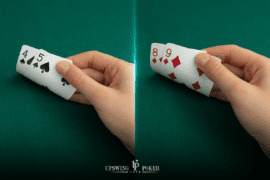
Tim is clear that he’s not raising 8d 7d from the Big Blind at 30bb versus a limp. He prefers a more polar approach and even points out that a hand like T2 offsuit makes more sense as a raise candidate.
On the flop, raising runs into a practical issue that Mike highlights. Against a lot of live players, if you raise and face a jam, you’re usually just up against a King, which puts you in a poor spot.
Calling keeps the pot manageable and lets you realize your equity without getting jammed on by better hands.
The turn is where the analysis really breaks down.

Picking up a flush draw gets treated by ChatGPT as if it meaningfully upgrades the hand to a made hand. Improving to a flush draw is not at all the same thing as making your flush.
Tim brings it back to the real options. You can check and take your equity, or apply pressure if you think your opponent is holding weaker pairs like 6x or 5x.
Mike gives this one a C-, which seems kind to the poor robot.
Hand 3: Where Population Reads Need Precision

Nothing unusual preflop or on the flop.
Ad Js is a standard open, and on Kc Jh 4s, you can mix between checking and betting small, and Stu goes with the small bet. The turn checks through, which is also standard.
The key decision is on the river.
Facing a Small Blind lead, the analysis leans toward folding, pointing to population tendencies.
Tim and Mike both disagree. The price is good, and Ad Js is too strong to fold here.
If you believe your opponent is skewed toward value, the adjustment isn’t to fold everything—it’s to trim the weakest hands that would normally call. Mike points to hands like T9 as folds, while continuing with Jx.
Tim adds that in some cases, those weaker T9-type hands can even be turned into raises if the opponent is leaning too heavily on thin value.
Hand 4: Solver Reality Check

This one is short but clear.
The analysis correctly identifies that players limp too often and fold too much, creating an opportunity to apply pressure.
But it then claims that a solver wouldn’t jam 4d 4c for 28bb over a limp.
Tim pulls up the sim, and it’s a pure jam
The instinct to attack weak ranges is there, but the underlying structure isn’t, which leads to confident conclusions that don’t hold up.
Tim says:
ChatGPT is sort of a feel player, not really a solver player.
Hand 5: Always a Step Behind

This hand is the closest the analysis gets, but it still misses the mark.
Preflop, ChatGPT prefers a flat with Kd Td in the Small Blind versus an early position open and a call.
Tim prefers the aggressive option, going with a jam. The reason is that you fold out a lot of dominating Broadway hands and still have solid equity when called.
That opportunity gets missed.
On the flop, the analysis leans toward calling again, while Tim prefers raising more often, especially against a Button c-bet.
On the turn, he introduces leading as an option on the 6c, where the Big Blind can have straights and flushes and start applying pressure.
By the river, things settle down, and Tim is fine with the general approach, including Stu’s small block bet.
Tim says:
ChatGPT’s analysis is something like a 2/5 grinder who has played for 30 years and has never looked at a solver.
The Real Lesson
Needless to say, there’s a massive gulf between ChatGPT’s poker analysis and Timothy Adams’s poker analysis. This fun exercise just highlights the fact that there is no substitute for experience and expertise, no matter how sharp the LLM chatbot can be in some areas.
When it comes to poker strategy, you’ve got to stick to the real thing, and Modern Tournament Mastery is the place to find it.